Choosing a Competition Gown That Commands the Stage
A pageant stage is one of the most demanding environments a dress will ever face. Strong lighting, movement requirements, close judging proximity, and the need to stand out in a lineup of equally prepared competitors — it all comes down to the gown. Understanding what actually makes pageant gowns for women succeed on stage is the starting point for any serious competitor.
Stage Presence Starts With the Right Silhouette
Not every beautiful dress translates well under stage lighting. The silhouettes that consistently perform well are those with architectural integrity — gowns that hold their shape while allowing natural movement.
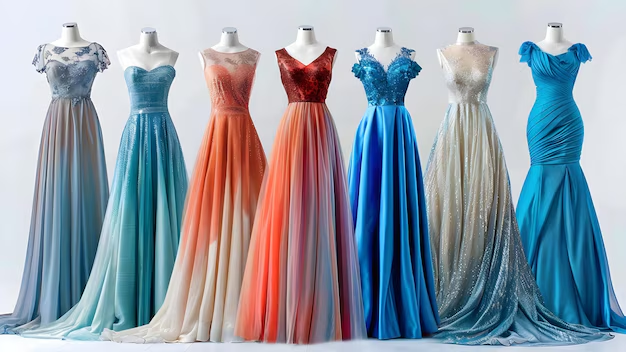
Ball gowns with full tulle or organza skirts create drama from a distance and photograph well at every angle. Mermaid silhouettes show off fitness and figure but require a confident stride — they can restrict natural movement if the fit is too snug. A-line styles offer the best compromise for newer competitors: flattering, movement-friendly, and visually clean.
Color Strategy Under Stage Lighting
Stage lighting has a flattening effect on color. Pastels that look beautiful in natural light can wash out entirely under bright stage washes. Deep, saturated tones — royal blue, deep fuchsia, emerald, and true red — hold their vibrancy and create strong visual contrast against most stage backdrops.
That said, color choice should always factor in skin tone. A shade that photographs as vibrant on one woman may read differently on another. When possible, test your gown under artificial lighting before competition day.
The Role of Embellishment
Beading, sequins, and crystal embellishments are a staple of competition dressing because they catch and reflect stage light beautifully. However, the weight and placement of embellishment matters. Heavy beadwork across the entire skirt can restrict movement and create fatigue during extended stage time. The most effective approach is strategic: concentrated embellishment at the bodice and upper skirt, fading to a cleaner hem. The National Pageant Association consistently emphasizes that judges evaluate how a competitor carries herself — not just how the gown looks standing still.
Fit and Movement Testing
Before any competition, practice your walk in the gown. Practice turning, stepping up to a microphone, and descending stairs if required. A dress that looks stunning in a mirror but causes visible discomfort or awkward movement undermines your entire performance.
When evaluating pageant gowns for women for competition use, prioritize construction quality: reinforced boning in the bodice, a well-secured zipper or corset back, and a hem length that’s been properly finished for your height.
Custom Versus Ready-to-Wear
Custom gowns offer the precision of a fit built around your measurements, but they require lead time — typically six to twelve weeks minimum — and a significant budget. Ready-to-wear competition gowns from designers who specialize in pageant styling have closed the gap considerably, with structured bodies, professional-grade embellishment, and fit options that accommodate alterations.
The most practical approach for most competitors is a high-quality ready-to-wear gown from a pageant-specific collection, altered to your measurements by a skilled tailor. This delivers a custom-looking result at a more accessible price point.
Presentation Strategy: How to Build a Winning Overall Look
A competitive stage look is built deliberately, not assembled randomly. Beyond the gown itself, successful contestants think in terms of visual hierarchy: what the audience notices first, what draws attention next, and what lingers in memory after the walk is complete.
Hair, makeup, jewelry, and posture should all be designed to frame the gown rather than compete with it. Over-accessorizing or over-styling can dilute impact on stage, especially under bright lighting where small details can disappear or become visually noisy.
Equally important is consistency between category requirements and styling decisions. A gown suited for evening wear or formal introduction may differ significantly from one designed for talent or on-stage question segments. Understanding these distinctions helps avoid over- or under-dressing for the moment.
Ultimately, the most effective competitors are those who understand that presentation is not about excess — it’s about control. Every detail should feel intentional, rehearsed, and aligned with how the competitor wants to be perceived on stage.
Final Thoughts
In pageantry, the gown is never judged in isolation. It’s evaluated as part of a complete presentation — walk, posture, confidence, and the ability to maintain composure under pressure. A technically perfect dress can still fall flat if the competitor appears uncertain or disconnected from what she’s wearing.
This is why final impressions often outweigh initial visual impact. Judges are not only observing how a gown looks when you enter the stage, but how it moves with you through transitions, turns, and exits. A well-chosen dress supports consistency: it doesn’t shift awkwardly, require constant adjustment, or distract from performance. Instead, it reinforces presence.
Competitors who perform best tend to treat the gown as an extension of their strategy, not just a style choice. That means rehearsing in full dress, understanding how fabric reacts under lighting, and ensuring that every element — from hemline to embellishment placement — works in motion, not just in still images.
For more information visit:- scribblesage