PM Modi Warned Europe But We Did Not Listen: Belgian Prime Minister Admits Mistake as EU Rethinks China Dependence
Belgian Prime Minister Bart De Wever has acknowledged that Europe failed to heed an earlier warning from Prime Minister Narendra Modi about the risks of excessive economic dependence.
Speaking at a Confederation of Indian Industry (CII) event in New Delhi during his September 2026 visit to India, De Wever said European countries had been slow to recognise the dangers of allowing economic dependencies to become strategic vulnerabilities.
“India saw this earlier than we did. And they warned us. And we didn’t listen,” De Wever said. He added that Modi had warned Europe about the issue long ago but was not listened to at the time. “But we are listening now,” he said.
His comments come as Europe faces growing concerns over Chinese competition, industrial pressure and vulnerabilities in critical supply chains.
What Did the Belgian Prime Minister Say About PM Modi’s Warning?
De Wever’s remarks were delivered against the backdrop of Europe’s changing approach to global trade.
He said Europe had allowed excess production to enter its markets at low prices, weakening parts of its industrial base while creating dependencies that could eventually be used as leverage.
“For Europe, these past years have been a rude awakening,” De Wever said, referring to the impact of overcapacity, industrial pressure and economic dependencies.
Although he did not repeatedly name China in his remarks, De Wever referred to the country that had benefited most from these developments as a nearby economic powerhouse. His comments were widely understood as a reference to China’s growing role in European supply chains and trade.
The Belgian leader also said Europe does not want economic dependencies to become “weaponised” against it.
Why Is Europe Worried About China?
Europe’s concerns go beyond the size of its trade relationship with China. European policymakers are increasingly focused on the effect of Chinese competition on domestic manufacturing and the security of critical supply chains.
Chinese companies have built strong positions in several industries that are important to Europe’s energy transition and manufacturing base. This has made diversification a growing priority for the European Union.
The issue has become particularly sensitive as European manufacturers face competition from lower-cost Chinese products and components.
European Manufacturing Jobs Face Pressure
The European metals industry has warned of significant employment losses as Chinese competition intensifies.
Industry association Eurometal has estimated that up to 300,000 manufacturing jobs could be lost by the end of 2026, citing competition from China and concerns about the effectiveness of European protection measures.
The warning highlights the pressure facing European industrial companies as they compete with Chinese producers in an increasingly globalised market.
How Dependent Is Europe on Chinese Supply Chains?
China has a particularly strong position in several sectors that Europe needs for manufacturing, renewable energy and technological development.
| Sector | Why It Matters |
|---|---|
| Solar panels | Essential for Europe’s renewable-energy expansion |
| Lithium-ion batteries | Critical for electric vehicles and energy storage |
| Critical raw materials | Needed for batteries, electronics, defence and clean technologies |
| Industrial components | Used across European manufacturing supply chains |
This dependence has become a strategic concern because disruptions to supplies can affect multiple industries at the same time.
For European policymakers, the question is no longer simply where products are cheapest. It is increasingly about whether critical supplies remain available during geopolitical or trade disputes.
Europe’s Plan to Reduce Strategic Dependence
The EU has already started changing its approach through policies designed to strengthen domestic production and diversify external suppliers.
One of the most important measures is the Critical Raw Materials Act, which aims to improve Europe’s ability to extract, process and recycle critical materials while reducing excessive dependence on individual foreign suppliers.
The legislation is part of a broader European strategy to build more resilient supply chains and strengthen the bloc’s industrial capacity.
The objective is not to end trade with China. Instead, the EU is seeking to avoid situations where a single external supplier becomes indispensable to an entire industry.
Why India Is Becoming More Important to Europe
This is where India’s role becomes increasingly significant.
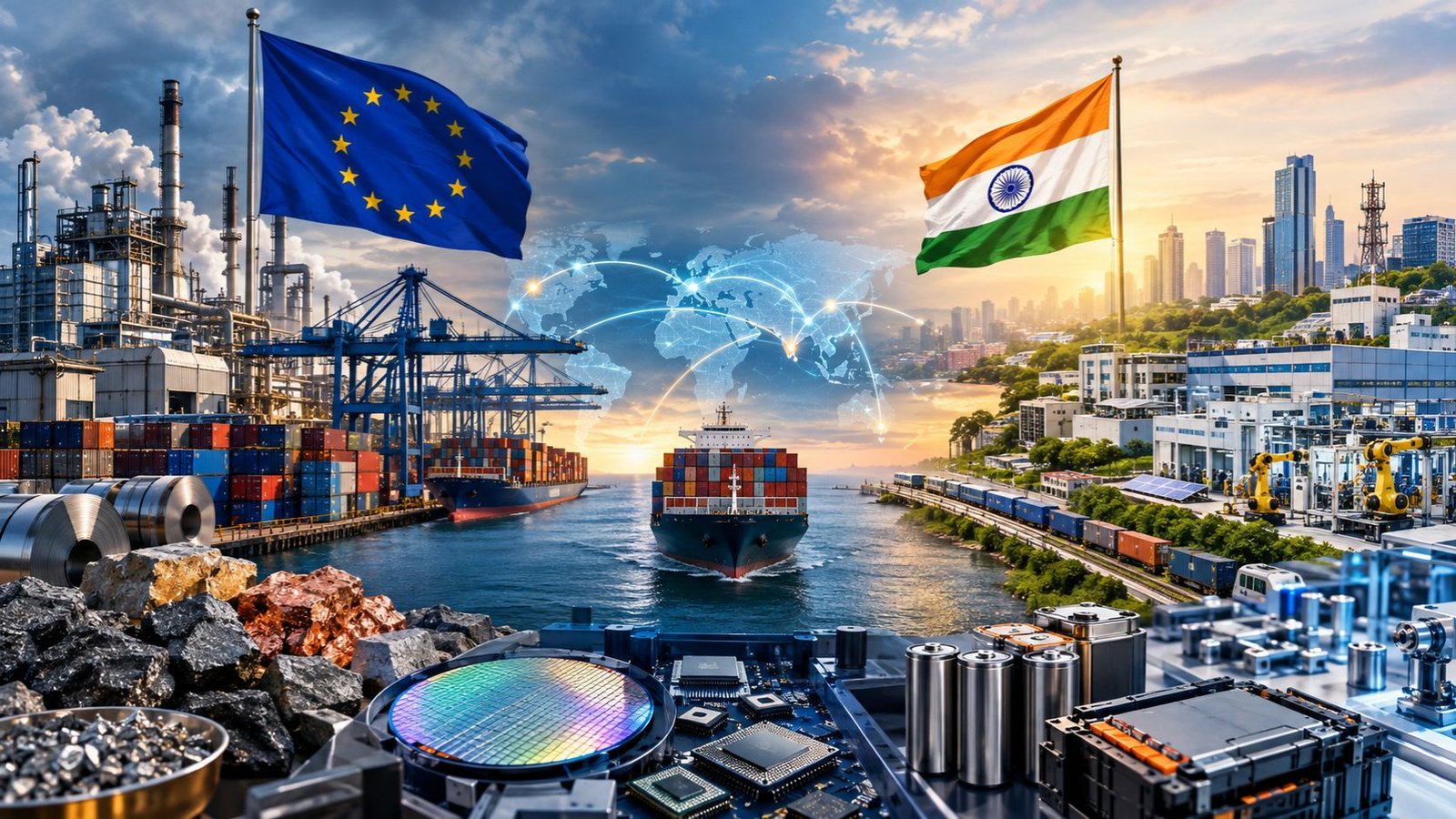
During De Wever’s visit, India and Belgium agreed to strengthen cooperation across areas including trade, defence, clean energy, critical minerals, semiconductors, research and technology. The two countries also agreed to work toward deeper investment and economic ties.
De Wever described India as an especially important partner for Europe and argued that countries with shared commitments to cooperation and a rules-based international system could play a greater role in the changing global economy.
The India-EU Free Trade Agreement is another important part of this relationship. The agreement is intended to expand trade and investment between the two markets while creating new opportunities across multiple sectors.
What Does This Mean for India and Europe?
De Wever’s comments reflect a broader shift in Europe’s thinking about economic security.
For years, efficiency and access to low-cost goods were major factors behind global supply chains. But geopolitical tensions have increasingly pushed governments to consider another question: What happens when economic dependence becomes a strategic vulnerability?
Europe is now looking to diversify its suppliers and strengthen partnerships with countries that can contribute to resilient supply chains.
For India, this creates an opportunity to expand its role in European trade and manufacturing networks.
The potential areas are broad, ranging from critical minerals and pharmaceuticals to semiconductors, clean energy, technology and defence. India and Belgium have already identified several of these sectors for deeper cooperation.
Why De Wever’s Remarks Matter
The significance of De Wever’s statement lies less in the criticism of any single country and more in his acknowledgement that Europe underestimated the risks of economic dependence.
His message was direct: India identified the problem earlier, Europe did not act quickly enough, and European governments are now reassessing their position.
That reassessment comes at a time when Chinese competition is putting pressure on European industry and when policymakers are increasingly concerned about the resilience of critical supply chains.
For India, the remarks also underline the country’s growing importance in Europe’s search for reliable economic and strategic partners.
Key Takeaways
- Belgian Prime Minister Bart De Wever said Europe ignored an earlier warning from PM Narendra Modi about economic dependence.
- De Wever made the remarks at a CII event in New Delhi during his September 2026 India visit.
- He described Europe’s experience with economic dependence as a “rude awakening.”
- His comments were widely understood as referring to China’s growing economic influence, although he did not name China in every part of his remarks.
- Eurometal has warned that Chinese competition could contribute to the loss of up to 300,000 European manufacturing jobs by the end of 2026.
- The EU is working to diversify critical supply chains and strengthen its industrial base.
- India is becoming a more important partner for Europe in trade, technology, critical minerals, clean energy and defence.
Frequently Asked Questions
When did Belgium’s PM say Europe ignored PM Modi’s warning?
Bart De Wever made the remarks during his September 2026 visit to India, including a keynote address at a Confederation of Indian Industry event in New Delhi.
What was PM Modi’s warning to Europe about?
According to De Wever, Modi had warned European leaders about the risks associated with excessive economic dependence. De Wever said Europe did not listen at the time but is now taking the issue more seriously.
Was De Wever directly talking about China?
China was not named in every part of De Wever’s remarks. However, his comments about economic overcapacity, dependencies and a nearby economic powerhouse were widely interpreted as a reference to China’s role in European markets and supply chains.
Why is Europe concerned about losing manufacturing jobs?
European industry groups argue that competition from Chinese producers is putting pressure on domestic manufacturers. Eurometal has estimated that up to 300,000 manufacturing jobs could be lost by the end of 2026.
Why is India becoming strategically important for Europe?
India is increasingly viewed as a major partner in areas including trade, critical minerals, semiconductors, clean energy, technology and defence. India and Belgium have also agreed to strengthen cooperation across several of these sectors.
Is Europe ending trade with China?
No. The current strategy is primarily about diversification and resilience, rather than ending trade with China. The EU is seeking to reduce excessive dependence on individual suppliers while strengthening its own industrial capabilities and developing alternative partnerships.