
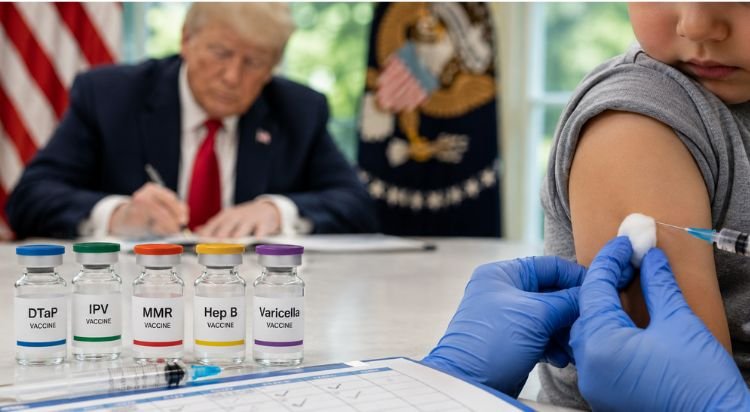
Trump Signs Executive Order Calling for Spacing Out Childhood Shots: What It Means
President Donald Trump signed an executive order on August 10 calling for major changes to the federal government’s recommendations for childhood vaccinations, including a plan to space some childhood shots across separate medical visits.
The order also calls for the combined measles, mumps and rubella (MMR) vaccine to eventually be offered as three separate vaccines and directs the U.S. Department of Health and Human Services (HHS) to develop recommendations for changes to the childhood immunization schedule.
The announcement has generated significant debate among parents, doctors and public health organizations. Supporters of the order say it could give families more flexibility, while medical organizations have raised concerns about delaying vaccinations and creating additional opportunities for children to miss recommended doses.
Importantly, the executive order does not automatically change every state’s school vaccination requirements. States have their own authority over school vaccine mandates.
Here is what the order means, what could change and where things currently stand.
What Did Trump’s Executive Order Say About Childhood Vaccines?
Trump’s August 10 executive order directs the federal government to reconsider how childhood vaccines are recommended and administered.
One of its central provisions calls for childhood vaccines to be administered during separate medical visits when feasible, rather than routinely giving multiple vaccinations during the same appointment.
The order also calls for changes to how vaccines are categorized and recommended for children.
According to the American Hospital Association’s summary of the order, the plan divides childhood immunizations into categories including vaccines recommended for all children, vaccines recommended for certain higher-risk groups and vaccines involving shared clinical decision-making.
The administration is also seeking public input on whether additional categories should be created.
What Does “Spacing Out Childhood Shots” Mean?
The phrase “spacing out childhood shots” refers to giving vaccinations at different appointments instead of administering multiple vaccines during one visit.
For example, rather than a child receiving several recommended vaccines during the same appointment, the proposed approach would separate vaccinations across multiple visits when possible.
Trump also said during the Oval Office signing event that one-year-olds should have their shots divided among five visits, although it was not immediately clear whether he was referring to every vaccine given at that age or a particular group of vaccinations.
The administration’s broader goal is to rethink the timing and combination of childhood vaccines.
Is Trump Separating the MMR Vaccine?
Yes. The executive order calls for the combined MMR vaccine to eventually be offered as three individual vaccines:
- Measles
- Mumps
- Rubella
The proposed approach would involve administering the vaccines separately and at different visits.
However, there is an important practical issue: separate measles, mumps and rubella vaccines for children are not currently available in the United States. The executive order therefore directs HHS to work toward developing a way to offer the individual vaccines.
The order also calls for continued availability of the combined MMR vaccine.
How Could the Childhood Vaccine Schedule Change?
The executive order goes beyond simply spacing out appointments.
The administration is seeking to narrow the group of vaccines recommended universally for children and create different recommendation categories.
The American Hospital Association reports that vaccines against 11 diseases are included in the category recommended for all children under the order, while some other vaccines would be recommended based on risk or through shared clinical decision-making.
Trump’s announcement also highlighted vaccines such as hepatitis B, influenza and COVID-19 as areas where the administration does not want the same universal recommendation approach.
The changes are part of a broader effort by the Trump administration and HHS to revise federal childhood vaccine guidance.
Does the Executive Order Immediately Change the Vaccine Schedule?
No.
This is one of the most important points for parents trying to understand the headline.
An executive order calling for revised recommendations is not the same thing as immediately replacing every vaccination policy used by doctors, schools and states.
The August 10 order directs federal agencies to take additional steps, including developing recommendations and working through the proposed changes. HHS subsequently issued a request for information on August 21 seeking public feedback on the categories and other issues raised by the order. Comments are due September 20.
That means the policy process is still developing.
Will Children Still Need Vaccines for School?
In many cases, yes, because states—not the federal government—generally control school vaccination requirements.
The executive order encourages states with school vaccine mandates to consider changes that would bring their requirements into line with the administration’s recommendations. But the federal order does not simply erase existing state laws.
This distinction is important because a change in federal vaccine recommendations does not automatically mean that a child is exempt from a state’s school-entry requirements.
Parents should therefore check the rules in their own state and speak with their child’s healthcare provider rather than assuming that the executive order immediately changed school requirements.
Why Does Trump Want Childhood Shots Spaced Out?
Trump has repeatedly argued that childhood vaccines should be administered differently and has questioned the number and timing of vaccinations given to children.
During the August 10 signing event, he again raised concerns about the combined MMR vaccine and discussed his belief that vaccines could be connected to autism.
However, those claims should be distinguished from the established scientific evidence.
Major medical organizations and researchers have repeatedly found no credible evidence that childhood vaccines cause autism. The question has been examined in numerous studies over many years.
The executive order itself directs HHS to conduct additional vaccine research, but reporting on the signing did not identify new scientific evidence demonstrating that spacing out routine childhood vaccines prevents autism.
What Do Doctors and Public Health Experts Say?
The proposed changes have received criticism from major medical and public health groups.
The concern is not simply about the number of injections a child receives during one appointment. Doctors also consider how long a child remains vulnerable to diseases before completing recommended vaccinations.
Public health experts have warned that spreading vaccinations across additional visits could increase the chance that a child becomes infected before receiving the next dose. There is also concern that requiring more appointments could make it easier for some children to miss vaccinations altogether.
The American Academy of Pediatrics has opposed the changes and argued that existing recommendations should continue to guide vaccination decisions.
Critics also point to the extensive research and safety monitoring behind existing childhood vaccination recommendations.
Does Giving Multiple Vaccines at One Visit Make Them Less Safe?
There is an important distinction between receiving multiple vaccines during one visit and receiving too much medication.
Vaccination schedules are designed around the timing at which children are expected to benefit from protection against particular diseases.
Medical experts cited in coverage of Trump’s order have said vaccines and combinations of vaccines undergo extensive clinical testing and continued safety monitoring.
Supporters of spacing out vaccines argue that parents should have more flexibility. Critics counter that additional appointments may delay protection or make it harder for children to complete the recommended series.
What About the MMR Vaccine and Autism?
The MMR vaccine has been at the center of the controversy because Trump has repeatedly discussed vaccines in connection with autism.
Scientific research does not support a causal connection between the MMR vaccine and autism.
The issue has been studied for decades, and medical organizations continue to state that vaccines, including MMR, do not cause autism.
That distinction matters when discussing the executive order because the administration’s proposed policy changes should not be presented as proof that vaccines cause autism.
The order calls for additional research, but additional research is not the same as evidence establishing a vaccine-autism connection.
What Happens to the MMR Vaccine Now?
For the time being, the combined MMR vaccine remains an important part of the discussion.
The administration wants HHS to develop a plan for offering individual measles, mumps and rubella vaccines for children. But those separate pediatric vaccines are not currently available in the United States.
The executive order also calls for maintaining availability of the combined vaccine, meaning the policy is not simply an immediate ban on MMR.
Any future change would require additional regulatory and public-health steps.
What Is HHS Doing Now?
The next phase of the policy process is already underway.
On August 21, HHS issued a request for information asking the public and interested organizations to provide feedback on how childhood vaccines should be categorized under the new framework.
HHS is specifically asking whether categories such as universal recommendations, risk-based recommendations and shared clinical decision-making are clear enough, and whether additional categories should be created.
The deadline for comments is September 20, 2026.
This means the August 10 executive order is not the end of the process. Federal agencies are still working through how the proposed framework would operate.
What Does the Order Mean for Parents?
For parents, the biggest question is whether they should immediately change their child’s vaccination schedule.
The executive order itself does not mean parents should independently delay or cancel scheduled vaccinations.
The federal policy is still being developed, and state requirements can differ. Parents should rely on their child’s pediatrician or other qualified healthcare professional for individual medical advice.
Parents should also avoid assuming that a headline about “spacing out shots” means all childhood vaccines have been suspended or that school vaccination requirements have disappeared.
Those are separate questions.
Why Is the Executive Order Controversial?
The controversy comes from a clash between the administration’s push for a different approach to childhood vaccines and the recommendations of many medical organizations.
Supporters of the policy argue that:
- Parents should have greater flexibility.
- More research into vaccine safety should be encouraged.
- Vaccination decisions can take individual circumstances into account.
- Separating vaccines could give parents more options.
Critics argue that:
- Delaying vaccinations could leave children vulnerable to preventable diseases.
- More appointments could increase the chance of missed doses.
- Existing childhood vaccine recommendations are supported by extensive research.
- Conflicting guidance could make it harder for parents to determine which recommendations to follow.
The debate is therefore about both vaccine timing and trust in public-health guidance.
What Happens Next?
Several developments could determine how Trump’s executive order affects childhood vaccination policy.
The immediate steps include:
- HHS will review public feedback on the proposed vaccine categories.
- Federal agencies will work on revised recommendations called for by the executive order.
- HHS has been directed to work on separate single-disease vaccines, beginning with MMR.
- States may decide whether to change their own vaccination rules.
- Medical organizations and other groups are likely to continue challenging or responding to the federal changes.
- Parents and healthcare providers will continue to navigate differences between federal recommendations and state requirements.
The September 20 deadline for HHS comments is therefore an important date to watch.
Trump Childhood Vaccine Executive Order: Key Facts
| Question | Answer |
|---|---|
| When did Trump sign the order? | August 10, 2026 |
| What is the main proposal? | Space childhood vaccinations across separate visits when feasible |
| What happens to MMR? | The administration wants measles, mumps and rubella vaccines offered separately |
| Are separate MMR vaccines currently available for U.S. children? | No |
| Does the order immediately change every state’s school vaccine laws? | No |
| Is the federal policy process finished? | No |
| When are HHS comments due? | September 20, 2026 |
| Does scientific evidence show that vaccines cause autism? | No credible evidence establishes such a causal link |
Frequently Asked Questions
Did Trump sign an executive order about childhood vaccines?
Yes. President Donald Trump signed an executive order on August 10, 2026, calling for significant changes to federal childhood vaccine recommendations, including spacing vaccinations across separate visits.
What does “spacing out childhood shots” mean?
It means administering childhood vaccines during separate medical appointments rather than routinely giving multiple vaccinations during the same visit.
Is Trump separating the MMR vaccine?
The executive order calls for the MMR vaccine to eventually be offered as three separate vaccines for measles, mumps and rubella. Separate pediatric versions are not currently available in the United States.
Does the executive order immediately change the childhood vaccine schedule?
No. The order begins a process for revising federal recommendations. HHS was still seeking public input on the proposed framework as of August 21, 2026.
Are childhood vaccines still required for school?
School vaccination requirements are generally controlled by individual states. The executive order encourages states to consider changes, but it does not automatically eliminate existing state requirements.
Does the MMR vaccine cause autism?
No credible scientific evidence establishes that MMR or other childhood vaccines cause autism. Decades of research have examined the question.
What should parents do about upcoming vaccinations?
Parents should not assume that the executive order automatically means they should delay or cancel a child’s scheduled vaccination. Because recommendations and requirements can vary, parents should discuss their child’s vaccination schedule with a qualified healthcare professional.
Bottom Line
Trump’s executive order is an attempt to significantly reshape how childhood vaccines are recommended in the United States.
The most visible proposal is to space childhood shots across separate medical visits and eventually offer separate measles, mumps and rubella vaccines instead of relying only on the combined MMR shot. The administration is also seeking changes to the categories used for childhood vaccine recommendations.
But the changes are not an overnight replacement of every vaccination rule in the country. The federal government still has work to do, HHS is gathering public feedback, and states retain authority over school vaccination requirements.
For parents, the situation is still developing. The next major milestone is HHS’s September 20 deadline for public comments on the proposed vaccine recommendation framework.
This article is for news and informational purposes and is not a substitute for individualized medical advice. Parents should consult a qualified healthcare professional about vaccination decisions for their children.