
Bangladesh Signals Interest in Makkah Defence Pact: What It Means for India, Pakistan and the Region
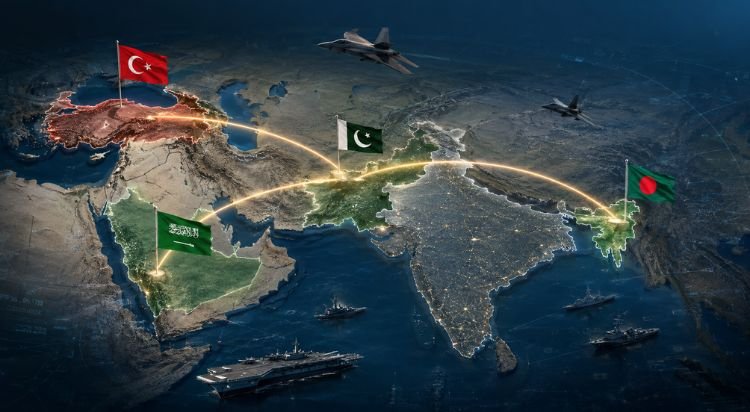
Bangladesh has signalled that it is open to joining the Makkah Joint Defence Agreement involving Pakistan, Saudi Arabia and Türkiye, potentially adding a new South Asian dimension to an emerging security framework.
The development has attracted attention in India and beyond because Bangladesh shares a land border with India, while Pakistan is already a member of the arrangement. However, Bangladesh has not formally joined the pact, and its final decision remains subject to its national interests and broader foreign-policy considerations.
The agreement, signed by Saudi Arabia, Pakistan and Türkiye on August 7, 2026, includes a collective-defence provision under which an armed attack against one member is to be treated as an attack against all three.
Key Takeaways
- Bangladesh has expressed openness to considering the Makkah defence arrangement.
- Bangladesh has not yet formally joined the pact.
- The existing agreement brings together Saudi Arabia, Pakistan and Türkiye.
- The pact contains a mutual-defence commitment between its current members.
- Bangladesh’s possible participation is particularly significant because it borders India.
- Analysts have raised questions about the potential impact on India’s eastern security environment.
- The phrase “Islamic NATO” is a media and analytical description, not the official name of the agreement.
- Bangladesh says any decision will be based on its own national interests.
Bangladesh Signals Openness to the Defence Pact
The latest development follows comments from Bangladesh’s Foreign Affairs Adviser Humayun Kabir, who indicated that Dhaka has a positive approach toward the possibility of joining a security or defence framework involving Pakistan, Saudi Arabia and Türkiye.
Kabir has stressed that Bangladesh would consider the country’s national interests and changing circumstances when evaluating such an arrangement.
That distinction is important. Bangladesh has expressed interest in the possibility, but there has been no formal announcement confirming that it has decided to become a member.
The issue therefore remains one to watch as Bangladesh assesses the diplomatic, economic and security implications of closer defence cooperation with the three existing members.
What Is the Makkah Joint Defence Agreement?
Saudi Arabia, Pakistan and Türkiye signed the Makkah Joint Defence Agreement on August 7, 2026, during a trilateral meeting in Makkah.
The agreement establishes a framework for closer defence and security cooperation between the three countries. One of its most significant elements is its collective-defence principle: an armed attack against one member is to be considered an attack against all three.
The agreement emerged amid a period of heightened regional security concerns, particularly in the Middle East.
For Pakistan, the arrangement also provides an opportunity to deepen strategic and defence ties with Saudi Arabia and Türkiye, while Riyadh and Ankara gain a framework for closer security coordination with Islamabad.
Why Is It Being Called “Islamic NATO”?
The term “Islamic NATO” has appeared in media reports and geopolitical commentary about the agreement.
However, it is important to make one point clear: “Islamic NATO” is not the official name of the pact.
The comparison comes largely from the collective-defence provision, which is reminiscent of NATO’s Article 5 principle that an attack against one member is treated as an attack against the alliance.
The two organisations should nevertheless not be treated as equivalent.
NATO has a much larger membership, permanent political institutions, an integrated military command structure and decades of established defence cooperation. The Makkah arrangement is considerably newer and its future institutional and operational structure remains to be developed.
Calling it an “Islamic NATO” is therefore best understood as a shorthand used by commentators rather than a description of an already established NATO-style military alliance.
Why Is Bangladesh Considering Membership?
Bangladesh’s stated approach is centred on its own national interests.
Dhaka has increasingly sought to maintain and expand relationships with multiple international partners, including countries in the Middle East and the wider Muslim world.
Joining or cooperating with the Makkah framework could potentially offer Bangladesh additional opportunities in defence cooperation, military training, technology and diplomatic engagement.
It could also strengthen its relationships with Saudi Arabia and Türkiye, both of which have important economic and political links with Bangladesh.
At the same time, such a decision would have to be weighed against Bangladesh’s existing relationships with India, China and other major international partners.
For Dhaka, the challenge would be finding a balance between deeper security cooperation and maintaining its broader strategic autonomy.
Why Bangladesh’s Possible Entry Matters to Pakistan
Bangladesh’s geographic position is one of the main reasons its potential membership has attracted attention.
Pakistan is located on India’s western side, while Bangladesh shares a long border with India in the east. If Bangladesh eventually became part of the Makkah defence arrangement, the pact would consequently gain a strategic presence in South Asia as well as its existing position in the Middle East.
For Pakistan, this could provide greater diplomatic and strategic depth.
However, membership in a collective-defence framework would not automatically mean that Bangladesh would participate in a military operation against India. The exact obligations of any future Bangladeshi membership would depend on the terms agreed between Dhaka and the existing members.
That distinction is important when assessing the potential consequences.
Why India Is Watching Closely
Bangladesh’s possible participation has particular significance for India because of the two countries’ shared border.
Pakistan is already a major factor in India’s western security calculations. A defence arrangement involving Pakistan and Bangladesh could therefore introduce another element into India’s assessment of its eastern neighbourhood.
This is why some analysts have raised the possibility of a future two-front security challenge.
However, it would be premature to describe that scenario as an established outcome.
Bangladesh has not announced any intention to attack India, nor has it committed to participating in a future conflict against New Delhi.
The immediate issue is instead the possibility that Bangladesh’s membership could alter the strategic environment in which India plans its regional security policy.
Could This Create a Two-Front Challenge for India?
The geographical argument is straightforward.
India shares its western border with Pakistan and its eastern border with Bangladesh. If both countries became members of the same collective-defence framework, Indian policymakers would have to consider how the new arrangement might affect their strategic planning.
But a defence pact does not automatically translate into coordinated offensive military action.
The actual impact would depend on several factors, including the terms of Bangladesh’s membership, the degree of military integration among the members and the circumstances surrounding any future conflict.
For that reason, describing Bangladesh’s possible accession as automatically creating a two-front war would go beyond the available evidence.
A more accurate assessment is that it could increase India’s strategic concerns and require additional planning for a changing regional security environment.
The “Bangladesh First” Approach
The debate also fits into Bangladesh’s broader effort to pursue a foreign policy centred on its own interests.
The phrase “Bangladesh First” has been used in connection with Dhaka’s approach to international relations. Rather than aligning itself permanently with one geopolitical camp, Bangladesh has sought relationships with a range of countries.
That includes neighbouring India, China, Pakistan and countries in the Middle East, as well as Türkiye and Western partners.
The Makkah pact presents a more complicated choice because it is not simply an economic or diplomatic partnership. It is a defence arrangement with a collective-security component.
Any decision to join would therefore represent a more significant strategic commitment.
What Could Bangladesh Gain?
If Bangladesh eventually joins the arrangement, several potential benefits could follow.
Possible benefits
- Greater defence cooperation with Saudi Arabia, Pakistan and Türkiye
- Increased military training and exchanges
- Potential cooperation in defence technology
- Stronger diplomatic ties with influential Muslim-majority countries
- Greater engagement with Middle Eastern partners
- Additional opportunities for security cooperation
But membership could also create challenges.
Possible risks
- Greater diplomatic friction with India
- Complications in Bangladesh’s relationships with other major powers
- Reduced room for strategic neutrality
- Greater involvement in regional security disputes
- Additional pressure to align with other members on sensitive geopolitical issues
The final decision would therefore involve a calculation of both strategic benefits and diplomatic costs.
The Bay of Bengal Dimension
Bangladesh’s potential inclusion would also give the emerging arrangement a stronger presence in the Bay of Bengal.
The existing members occupy strategically important positions across different regions. Saudi Arabia is positioned around the Red Sea and Persian Gulf, Pakistan has access to the Arabian Sea, and Türkiye has strategic access linking Europe, the Middle East and the Mediterranean.
Bangladesh would add another geographic dimension through the Bay of Bengal.
That could increase the overall geopolitical reach of the group, although geographic presence should not be confused with automatic military control or operational dominance.
The extent of future naval exercises, defence cooperation and military coordination would determine how significant this geographic expansion actually becomes.
A Test for Bangladesh’s Foreign Policy
The Makkah pact could ultimately become an important test of Bangladesh’s ability to balance competing strategic relationships.
India remains an important neighbour and economic partner. At the same time, Bangladesh has growing engagement with Pakistan, Türkiye and Saudi Arabia.
A decision to join the defence pact could strengthen some of those relationships while potentially creating new complications with others.
That makes the issue bigger than a simple question of military cooperation. It is also a question of how Bangladesh sees its role in an increasingly competitive geopolitical environment.
What Happens Next?
For now, the most important point is that Bangladesh has not formally joined the Makkah Joint Defence Agreement.
Dhaka has indicated that it is open to considering the possibility, but any decision will depend on its assessment of national interests, foreign-policy priorities and the changing regional environment.
The next stage will likely involve further diplomatic discussions between Bangladesh and the existing members.
The response from India will also remain important as New Delhi assesses whether the potential expansion of the pact could affect its strategic environment.
At the same time, the future importance of the Makkah agreement itself will depend on how Saudi Arabia, Pakistan and Türkiye develop the framework. Its long-term influence will become clearer as the members establish practical mechanisms for military cooperation, exercises, defence coordination and other forms of security collaboration.
Bottom Line
Bangladesh’s openness to considering the Makkah Joint Defence Agreement is an important development in South Asian and Middle Eastern geopolitics, but it is not the same as Bangladesh joining the pact.
The agreement currently links Saudi Arabia, Pakistan and Türkiye through a collective-defence framework. If Bangladesh eventually becomes a member, the arrangement would gain a new South Asian dimension and could influence strategic calculations involving India, Pakistan and the Bay of Bengal.
For now, however, the story is about Bangladesh considering the option—not about a confirmed new member.
Whether Dhaka ultimately joins, negotiates special conditions or decides to remain outside the arrangement will be one of the key geopolitical questions to watch in the coming months.


The article puts the subject into a broader investing context, which I found helpful.
how to read volume profile