
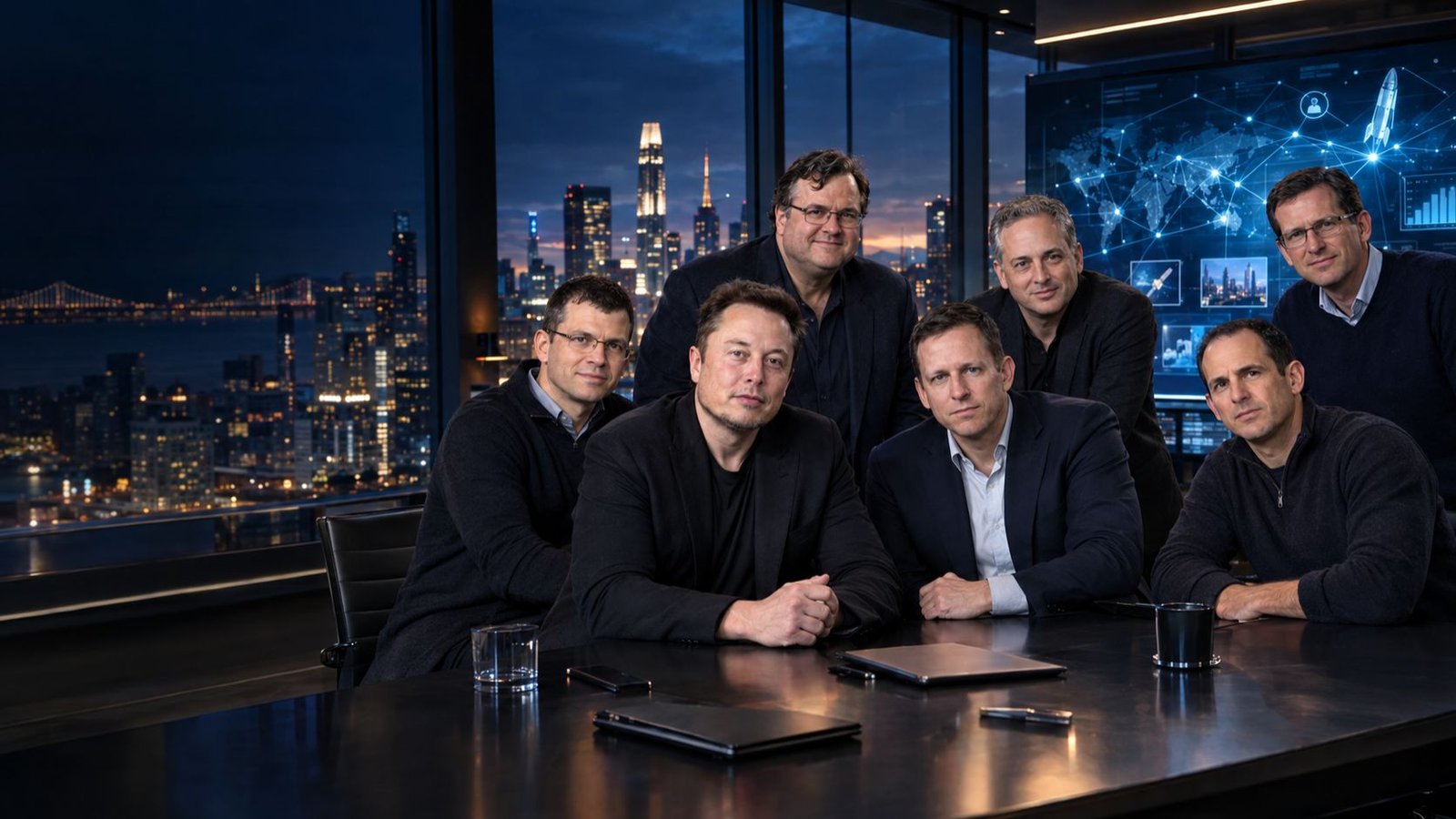
PayPal Mafia Members and What They Are Known For
Peter Thiel
Peter Thiel is one of the central figures in the PayPal story.
He was one of the founders of Confinity, the company that developed PayPal, and later served as PayPal’s CEO.
After PayPal, Thiel became involved in venture capital and founded or helped establish several important technology and investment organizations.
He became particularly well known for Palantir Technologies and Founders Fund.
His career illustrates one of the defining characteristics of the PayPal Mafia: using the experience and capital gained from one successful technology company to build and finance the next generation of startups.
Elon Musk
Elon Musk is perhaps the most recognizable name associated with the PayPal Mafia.
Musk founded X.com, an online financial services company, in 1999. X.com later merged with Confinity, the company behind PayPal’s early payment service. The merged business eventually became PayPal.
Musk later became one of the world’s most prominent technology entrepreneurs through companies and ventures including SpaceX and Tesla.
However, it is important to describe his PayPal history accurately. Saying simply that “Elon Musk founded PayPal” leaves out the complicated history involving X.com, Confinity and their merger.
A more accurate description is that Musk founded X.com, which merged with Confinity in 2000, creating the company that evolved into PayPal.
Max Levchin
Max Levchin was one of the key technical figures behind PayPal.
He co-founded Confinity with Peter Thiel and Luke Nosek and served as its chief technology officer.
Levchin’s technical expertise was central to PayPal’s early development.
After PayPal, he continued building technology businesses and eventually founded Affirm, a major financial technology company focused on consumer payments and financing.
Reid Hoffman
Reid Hoffman was an early PayPal executive who later became famous as the co-founder of LinkedIn.
His career demonstrates how the PayPal network expanded beyond payments.
Hoffman became an influential entrepreneur, investor and technology executive, and his later work helped connect the PayPal alumni network with another generation of Silicon Valley startups.
David O. Sacks
David O. Sacks was another important PayPal executive.
After PayPal, Sacks founded Yammer, an enterprise social networking company that was later acquired by Microsoft.
He subsequently became involved in venture capital through Craft Ventures, further extending the PayPal network into startup investing.
Roelof Botha
Roelof Botha served as PayPal’s chief financial officer.
After PayPal, he became a prominent venture capitalist at Sequoia Capital, one of Silicon Valley’s best-known investment firms.
Botha’s career is an important example of how PayPal alumni moved into venture capital and began influencing startups beyond the companies they personally founded.
Steve Chen, Chad Hurley and Jawed Karim
Three former PayPal employees—Steve Chen, Chad Hurley and Jawed Karim—went on to create one of the internet’s most important platforms: YouTube.
Their PayPal experience preceded their work on YouTube, which they co-founded in 2005.
This is one of the clearest examples of the PayPal network producing a major technology company after PayPal.
Keith Rabois
Keith Rabois was an early PayPal executive who later became an entrepreneur and investor.
He has been involved with multiple technology companies and venture investments, making him another important link between the original PayPal network and later generations of Silicon Valley startups.
Luke Nosek
Luke Nosek was one of the original co-founders of Confinity alongside Peter Thiel and Max Levchin.
After PayPal, Nosek became involved with Founders Fund, extending his influence into venture capital and startup investing.
Who Founded PayPal?
The answer is more complicated than simply naming one person.
The history of PayPal begins with Confinity, which was founded in 1998 by Max Levchin, Peter Thiel and Luke Nosek. Confinity initially worked on security and payment technology before developing PayPal.
Separately, Elon Musk founded X.com in 1999 as an online financial services company.
In March 2000, X.com and Confinity merged. The combined company initially retained the X.com name, while the PayPal payment service became the company’s dominant product. The business eventually adopted the PayPal name.
So, when someone asks “Who founded PayPal?”, the most useful answer is that PayPal grew out of Confinity’s payment business and the merger with Elon Musk’s X.com.
Who Started PayPal With Elon Musk?
Elon Musk did not create PayPal entirely on his own.
Musk founded X.com, while Max Levchin, Peter Thiel and Luke Nosek were among the key founders of Confinity, the company that developed the original PayPal payment service.
The two businesses merged in 2000.
That merger is one of the most important events in the history of PayPal and explains why discussions about the company’s founders can become confusing.
Who Were the Original PayPal Founders?
The answer depends on whether someone is referring to Confinity, X.com, or the later PayPal company.
Confinity
The original Confinity founders included:
- Peter Thiel
- Max Levchin
- Luke Nosek
X.com
X.com was founded by:
- Elon Musk
- Harris Fricker
- Christopher Payne
- Ed Ho
Confinity and X.com subsequently merged, creating the corporate history from which modern PayPal emerged.
This is why referring to one person as the sole “inventor of PayPal” is misleading.
How Did the PayPal Mafia Form?
The story starts before the term “PayPal Mafia” existed.
Before PayPal
In 1998, Max Levchin, Peter Thiel and Luke Nosek founded Confinity.
The company’s early work focused on security and technology for handheld devices before it shifted toward digital payments.
The PayPal service emerged from this work in 1999.
At roughly the same time, Elon Musk was building X.com.
The Formation of PayPal
Confinity and X.com merged in 2000.
The online payment business proved to be the most promising part of the combined company, particularly as PayPal gained traction among eBay users.
PayPal’s growth was closely connected to the rapidly expanding online auction marketplace, where buyers and sellers needed a faster alternative to checks and money orders.
The company eventually changed its corporate name to PayPal.
The eBay Acquisition
PayPal went public in February 2002.
Later that year, eBay agreed to acquire PayPal for approximately $1.5 billion.
The acquisition became a major turning point for the people who had built PayPal.
Former employees and executives now had capital, experience and an unusually strong network of other entrepreneurs.
Instead of simply moving into traditional corporate jobs, many began building new companies.
That was the beginning of the phenomenon that eventually became known as the PayPal Mafia.
PayPal Mafia Companies
The PayPal Mafia’s influence can be seen through the companies its members founded, co-founded, led or invested in.
Some of the most notable examples include:
| Company | Connection to PayPal Mafia |
|---|---|
| YouTube | Founded by former PayPal employees |
| Founded by Reid Hoffman | |
| Yelp | Founded by former PayPal employees |
| Palantir | Co-founded by Peter Thiel and others |
| SpaceX | Founded by Elon Musk |
| Affirm | Founded by Max Levchin |
| Yammer | Founded by David Sacks |
| Founders Fund | Co-founded by PayPal alumni |
| Craft Ventures | Founded by David Sacks and others |
These companies span social media, enterprise software, aerospace, financial technology and venture capital.
That diversity is one reason the PayPal Mafia remains such an important subject in technology history.
The Biggest Companies Founded by PayPal Mafia Members
YouTube
YouTube was founded in 2005 by Steve Chen, Chad Hurley and Jawed Karim, all former PayPal employees.
The platform transformed online video and eventually became one of the world’s most important internet platforms.
Its connection to PayPal is one of the clearest examples of former PayPal employees turning their experience into another major technology company.
Reid Hoffman co-founded LinkedIn.
The professional networking platform became a major part of the modern internet economy and eventually grew into a dominant professional social network.
Hoffman’s PayPal background gave him experience in building internet businesses during the company’s formative years.
Yelp
Jeremy Stoppelman and Russel Simmons, both associated with PayPal, went on to co-found Yelp.
Yelp applied internet technology to a different problem: helping consumers discover and evaluate local businesses.
Palantir
Peter Thiel was one of the central figures behind Palantir.
The company developed software focused on data analysis and information management and became one of the best-known technology companies associated with the PayPal network.
SpaceX
Elon Musk founded SpaceX in 2002, shortly after the PayPal sale.
SpaceX took the PayPal-era entrepreneurial story into an entirely different industry: aerospace.
Its development helped establish Musk as a major figure far beyond online payments.
Affirm
Max Levchin later founded Affirm.
The company applied Levchin’s technology and financial expertise to consumer financing and payments.
Affirm is another example of PayPal alumni continuing to work at the intersection of technology and financial services.
Yammer
David Sacks founded Yammer, an enterprise social networking company.
Microsoft later acquired Yammer, making it another notable company created by a former PayPal executive.
The PayPal Mafia’s Venture Capital and Investment Network
The PayPal Mafia’s influence isn’t limited to companies its members personally founded.
Former PayPal executives also became investors and venture capitalists.
This created a second layer of influence.
Instead of building one company at a time, members of the network could provide money, advice and connections to many startups simultaneously.
Founders Fund
Peter Thiel and Luke Nosek were among the figures associated with Founders Fund, which became one of Silicon Valley’s prominent venture firms.
Sequoia Capital
Roelof Botha moved from PayPal into venture capital at Sequoia Capital, where he became an influential investor.
Craft Ventures
David Sacks later became associated with Craft Ventures, continuing the PayPal tradition of combining entrepreneurship with startup investing.
The result was a network in which PayPal alumni could influence companies even when they weren’t the founders.
How Many Companies Did the PayPal Mafia Create?
There isn’t a single official number.
That’s because “created” can mean several different things.
A PayPal Mafia member might have:
- Founded a company
- Co-founded a company
- Served as an executive
- Invested as an angel investor
- Invested through a venture capital firm
- Advised a startup
- Joined a company’s board
For that reason, claims that the PayPal Mafia collectively “founded hundreds of companies” should be treated carefully.
The more important point is that the network’s influence extends far beyond the companies directly founded by its most famous members.
PayPal Mafia Net Worth
There is no official PayPal Mafia net worth.
The group is not a company or legal entity, so it has no collective balance sheet.
Individual members have accumulated wealth through:
- Startup ownership
- Public-company shares
- Venture capital
- Private investments
- Company acquisitions
- Stock-market gains
- Founder equity
Some members became billionaires or multimillionaires, but their fortunes are separate.
A combined figure can therefore be misleading, especially because the value of privately held companies and investment portfolios can change significantly.
The important financial event that helped establish the network was PayPal’s sale to eBay in 2002. The proceeds gave several former employees capital that they could subsequently deploy into new companies and investments.
PayPal Mafia and Elon Musk
Elon Musk’s connection to the PayPal Mafia is one of the most searched aspects of the story.
Musk founded X.com in 1999.
X.com later merged with Confinity, the company behind PayPal’s payment service. Musk subsequently became CEO of the combined company for a period before being replaced later in 2000.
PayPal eventually went public and was acquired by eBay in 2002.
Musk then moved on to other ventures, including SpaceX.
His PayPal experience therefore represents one chapter in a much larger entrepreneurial career.
Did Elon Musk Found PayPal?
The most accurate answer is not in the simple sense that he founded PayPal by himself.
Musk founded X.com, which merged with Confinity.
Confinity had developed the PayPal payment service under founders including Peter Thiel, Max Levchin and Luke Nosek.
The merger created the corporate history that eventually produced PayPal.
So Musk was a major figure in PayPal’s early history, but describing him as the sole founder of PayPal would be inaccurate.
How Is Elon Musk Connected to the PayPal Mafia?
Musk is considered part of the PayPal Mafia because of his role in the X.com and PayPal story and his later entrepreneurial relationship with other former PayPal figures.
His post-PayPal career also demonstrates the scale of the network’s influence.
From online payments, the former PayPal ecosystem spread into aerospace, social networking, enterprise software, financial technology and venture capital.
PayPal Mafia Network: Who Is Connected to Whom?
The easiest way to understand the network is to think of it as a web rather than a hierarchy.
PayPal
↓
Peter Thiel → Palantir → Founders Fund
Elon Musk → SpaceX → Tesla
Max Levchin → Affirm
Reid Hoffman → LinkedIn
David Sacks → Yammer → Craft Ventures
Steve Chen → YouTube
Chad Hurley → YouTube
Jawed Karim → YouTube
Jeremy Stoppelman → Yelp
Roelof Botha → Sequoia Capital
This network became powerful because the relationships did not stop when people left PayPal.
Former colleagues became founders, investors, board members and advisers to one another.
Why Was the PayPal Mafia So Successful?
The PayPal Mafia’s success cannot be explained by one factor.
Several advantages came together.
Shared PayPal Experience
Members had already worked through the challenges of building a rapidly growing internet company.
They had experience with product development, payments, hiring, fundraising, competition and scaling.
Silicon Valley Network Effects
A successful entrepreneur rarely works alone.
Former PayPal employees could introduce one another to investors, engineers, executives and other founders.
Every successful company created another set of relationships.
Access to Capital
The eBay acquisition gave some former PayPal executives substantial financial resources.
That meant they could become angel investors themselves rather than relying entirely on outside investors.
Technical Expertise
PayPal attracted technically skilled employees who later became founders.
Their expertise could be transferred into entirely different industries.
Founder-to-Founder Support
Perhaps the biggest advantage was trust.
People who had already worked together could recommend one another, invest together and recruit from the same network.
That created a compounding effect.
One successful startup could produce several new founders and investors, who could then support another generation of companies.
What Companies Does PayPal Own?
This is an important distinction because PayPal and the PayPal Mafia are not the same thing.
PayPal is a corporate entity.
The PayPal Mafia is an informal network of former employees and founders.
A company founded by a former PayPal employee does not automatically belong to PayPal.
For example, YouTube was founded by former PayPal employees, but that does not mean YouTube was owned by PayPal.
Likewise, SpaceX was founded by Elon Musk after his PayPal years but is not a PayPal company.
This distinction helps avoid one of the most common misconceptions about the PayPal Mafia.
PayPal vs. the PayPal Mafia
| PayPal | PayPal Mafia |
|---|---|
| A technology and payments company | An informal professional network |
| Has a corporate structure | Has no formal corporate structure |
| Provides financial technology services | Includes entrepreneurs and investors |
| Has shareholders and executives | Has no collective ownership |
| Operates as a business | Represents connections among former PayPal people |
The two terms are therefore related historically but have completely different meanings.
Frequently Asked Questions About the PayPal Mafia
What is the PayPal Mafia?
The PayPal Mafia is an informal network of former PayPal founders, executives and employees who later founded, led or invested in major technology companies.
Who are the PayPal Mafia members?
Well-known members and associates include Peter Thiel, Elon Musk, Max Levchin, Reid Hoffman, David O. Sacks, Roelof Botha, Luke Nosek, Keith Rabois, Steve Chen, Chad Hurley, Jawed Karim, Jeremy Stoppelman and others.
Who founded PayPal?
PayPal developed from Confinity’s payment business and its merger with X.com. Confinity was founded by Peter Thiel, Max Levchin and Luke Nosek, while Elon Musk founded X.com.
Who started PayPal with Elon Musk?
Elon Musk’s X.com merged with Confinity, the company behind PayPal’s early payment service. Peter Thiel, Max Levchin and Luke Nosek were among Confinity’s founders.
Is Elon Musk part of the PayPal Mafia?
Yes. Musk is widely considered one of the most prominent members of the PayPal Mafia because of his role in X.com and the early PayPal company.
What companies did the PayPal Mafia create?
Companies associated with PayPal alumni include YouTube, LinkedIn, Yelp, Palantir, SpaceX, Affirm and Yammer.
Why are they called the PayPal Mafia?
The name describes the unusually close network of former PayPal employees who went on to build and finance many technology companies. It is a nickname, not a reference to an actual criminal organization.
How many PayPal Mafia members are there?
There is no official number because there is no formal membership list. Different definitions include different former employees, executives and founders.
Are PayPal Mafia members still connected?
Many former PayPal employees have continued to interact as founders, investors, advisers and venture capitalists. Their relationships have remained influential across Silicon Valley.
What is the PayPal Mafia’s net worth?
There is no official collective net worth because the PayPal Mafia is not a legal entity. Individual members have accumulated wealth through company ownership, investments, acquisitions and venture capital.
PayPal Mafia Members at a Glance
| Name | PayPal connection | Major company or venture |
|---|---|---|
| Peter Thiel | Co-founder | Palantir, Founders Fund |
| Elon Musk | X.com founder / PayPal executive | SpaceX |
| Max Levchin | Co-founder | Affirm |
| Reid Hoffman | Executive | |
| David O. Sacks | Executive | Yammer, Craft Ventures |
| Roelof Botha | CFO | Sequoia Capital |
| Luke Nosek | Co-founder | Founders Fund |
| Keith Rabois | Executive | Investing and startups |
| Steve Chen | Former employee | YouTube |
| Chad Hurley | Former employee | YouTube |
| Jawed Karim | Former employee | YouTube |
| Jeremy Stoppelman | Former employee | Yelp |
| Russel Simmons | Former employee | Yelp |
| Ken Howery | Early PayPal figure | Founders Fund |
Final Takeaway
The PayPal Mafia is much more than a memorable nickname.
It represents a remarkable network of entrepreneurs, executives and investors whose careers began or accelerated around PayPal and continued across Silicon Valley.
Peter Thiel moved into Palantir and venture capital. Elon Musk moved into companies such as SpaceX. Max Levchin built Affirm. Reid Hoffman co-founded LinkedIn. Steve Chen, Chad Hurley and Jawed Karim created YouTube. Other PayPal alumni went into Yelp, Yammer, venture capital and startup investing.
Their greatest legacy may not be any single company. It is the network itself.
PayPal created a concentration of technical talent, entrepreneurial experience, capital and relationships. After the company was sold to eBay, those resources were redistributed throughout Silicon Valley.
That is ultimately what makes the PayPal Mafia so fascinating: one technology company became the starting point for an entire generation of founders, investors and companies.