
Linear Model of Communication: Definition, Examples, Diagram, Advantages & Limitations
The linear model of communication is one of the oldest and simplest ways to understand how communication works. It explains how a message moves in a one-way direction from a sender to a receiver through a communication channel. Although modern communication is often interactive and involves continuous feedback, the linear model remains an essential concept in communication studies, marketing, advertising, public speaking, and mass media.
If you’ve ever watched a television advertisement, listened to a radio announcement, or attended a lecture where information flowed in one direction, you’ve experienced the linear communication model in action.
This guide explains what the linear model is, how it works, its components, real-life examples, advantages, limitations, and how it compares with other communication models.
What Is the Linear Model of Communication?
The linear model of communication is a one-way communication model in which a sender creates and transmits a message through a channel to a receiver, who interprets the message. Unlike two-way communication models, the receiver does not provide immediate feedback during the communication process.
In simple terms, communication follows a straight path:
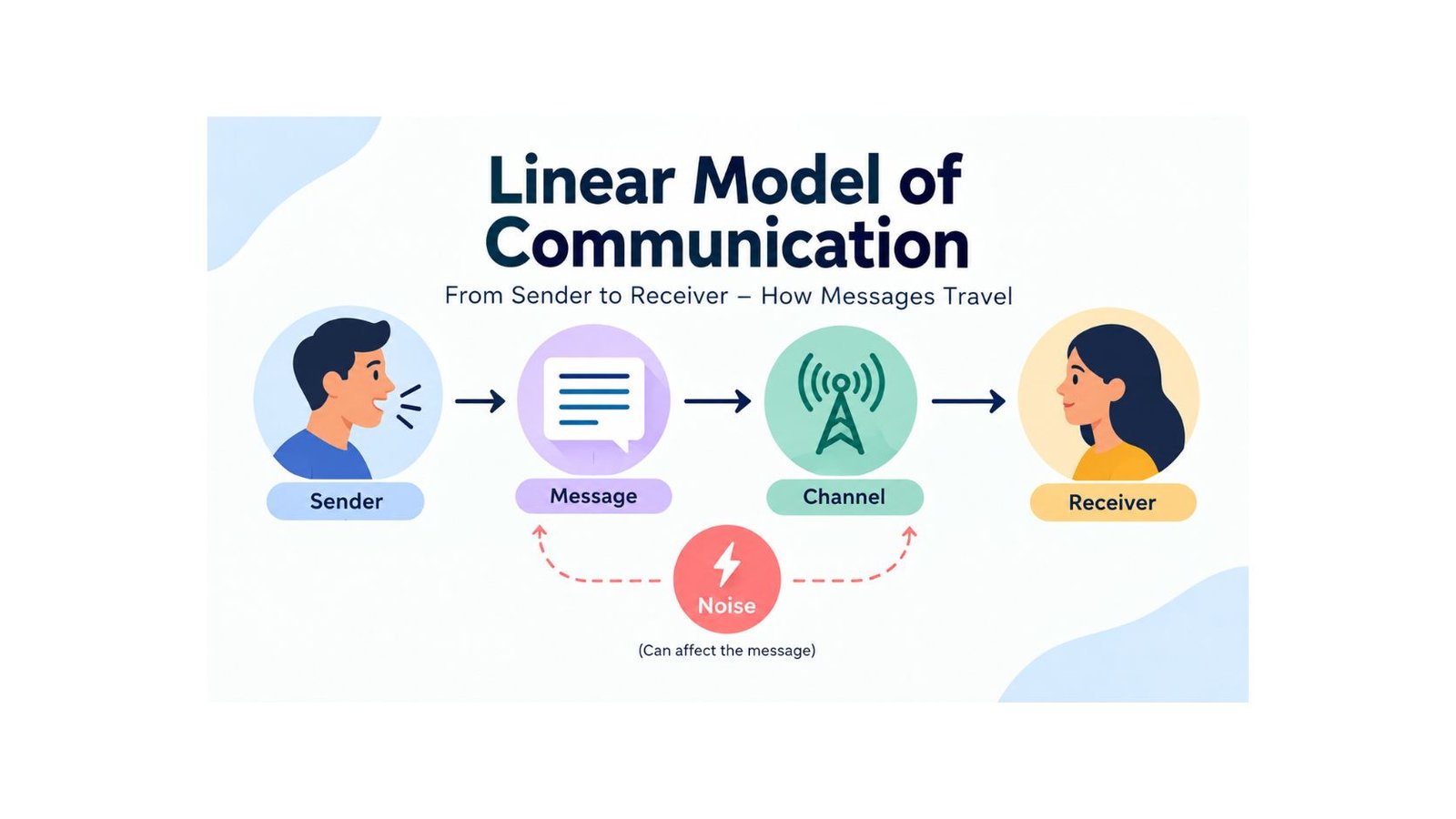
Sender → Message → Channel → Receiver
This model became widely recognized through the Shannon-Weaver Model (1948), which introduced the idea that “noise” could interfere with message transmission.
Quick Definition
The linear model of communication is a communication process where information flows in one direction from a sender to a receiver through a channel without immediate feedback.
Linear Model of Communication Diagram
The communication process can be visualized as a simple flow.
The message travels from the sender to the receiver, while various forms of noise may affect how accurately it is understood.
How the Linear Communication Model Works
The model follows a sequence of five simple steps.
Step 1: The Sender Creates the Message
Communication begins with the sender, who has an idea, opinion, instruction, or piece of information to share.
Examples include:
-
A teacher explaining a lesson
-
A company launching an advertisement
-
A politician giving a speech
The sender decides what message should be communicated.
Step 2: The Message Is Encoded
Before sending the message, the sender converts the idea into a communicable form. This process is called encoding.
Encoding may involve:
-
Spoken words
-
Written text
-
Images
-
Videos
-
Symbols
-
Gestures
For example, a company designing a billboard uses colors, images, and wording to communicate its message.
Step 3: The Message Travels Through a Channel
The channel is the medium that carries the message from the sender to the receiver.
Common communication channels include:
-
Television
-
Radio
-
Newspapers
-
Email
-
Posters
-
Public speeches
-
Digital advertisements
Choosing the right channel is important because different audiences respond differently to each medium.
Step 4: The Receiver Decodes the Message
Once the message reaches the receiver, they interpret its meaning through decoding.
The receiver’s understanding depends on factors such as:
-
Language skills
-
Previous knowledge
-
Culture
-
Personal experiences
-
Emotional state
Two people may interpret the same message differently depending on these factors.
Step 5: Noise May Affect Communication
One of the most important contributions of the linear communication model is recognizing noise, which refers to anything that interferes with communication.
Noise can occur at any stage of the process.
Components of the Linear Model of Communication
Each part of the model plays a specific role.
|
Component |
Role |
|---|---|
|
Sender |
Creates and sends the message |
|
Message |
The information being communicated |
|
Encoding |
Converts ideas into communicable form |
|
Channel |
Carries the message |
|
Receiver |
Receives and interprets the message |
|
Decoding |
Interprets the message |
|
Noise |
Interferes with communication |
Understanding these components makes it easier to analyze how communication succeeds—or fails.
Types of Noise in Communication
Noise is more than just loud sounds. It includes anything that changes or blocks the intended meaning.
Physical Noise
Physical noise comes from the environment.
Examples:
-
Traffic sounds
-
Construction work
-
Loud music
-
Poor microphone quality
Psychological Noise
Psychological noise comes from the receiver’s mental or emotional state.
Examples:
-
Stress
-
Anxiety
-
Anger
-
Distraction
A stressed employee may misunderstand an important announcement.
Semantic Noise
Semantic noise happens when words or symbols are misunderstood.
Examples:
-
Technical jargon
-
Complex vocabulary
-
Ambiguous phrases
Using simpler language often reduces semantic noise.
Technical Noise
Technical problems affect digital communication.
Examples:
-
Weak internet connection
-
Static during a phone call
-
Video buffering
These interruptions can prevent the receiver from getting the complete message.
Who Developed the Linear Model of Communication?
Several communication theorists contributed to the development of linear communication theory.
Shannon and Weaver (1948)
The Shannon-Weaver Model is the most influential linear communication model.
Originally developed for telephone communication, it introduced three major ideas:
-
Sender
-
Channel
-
Noise
Although created for engineering, it became one of the foundations of communication studies.
Lasswell’s Communication Model
Harold Lasswell proposed another famous linear communication formula:
Who says What in Which Channel to Whom with What Effect?
This model emphasizes analyzing communication by examining:
-
The communicator
-
The message
-
The channel
-
The audience
-
The outcome
It remains widely used in media and communication research.
Real-Life Examples of Linear Communication
The best way to understand the model is through practical examples.
Example 1: Television Advertisement
A sports brand creates a commercial promoting new running shoes.
-
Sender: Sports brand
-
Message: Buy our new shoes
-
Channel: Television
-
Receiver: Viewers
Viewers watch the advertisement without responding immediately.
Example 2: Radio Announcement
A weather department broadcasts a storm warning.
-
Sender: Weather agency
-
Message: Severe storm approaching
-
Channel: Radio
-
Receiver: Listeners
The announcement delivers important information quickly to a large audience.
Example 3: Classroom Lecture
A professor explains a topic while students listen.
-
Sender: Professor
-
Message: Lecture content
-
Channel: Speech
-
Receiver: Students
Although students may ask questions later, the lecture itself follows a mostly linear pattern.
Example 4: Political Speech
A politician addresses citizens during a public rally.
The audience receives the speech immediately, while feedback usually comes later through reactions, voting, or media discussions.
Example 5: Emergency Broadcast
Governments often use linear communication during emergencies.
Examples include:
-
Tsunami warnings
-
Earthquake alerts
-
Public safety announcements
These messages prioritize speed and clarity over immediate interaction.
Linear Model of Mass Communication
The linear model is especially useful in mass communication, where one sender communicates with a large audience.
Examples include:
-
Television broadcasts
-
Radio programs
-
Newspaper articles
-
Billboards
-
Public service announcements
In these situations, the sender cannot receive instant feedback from every audience member, making one-way communication practical.
Why It Works Well for Mass Communication
Mass communication often requires:
-
Fast information delivery
-
Consistent messaging
-
Large audience reach
-
Clear instructions
The linear model supports these goals effectively.
Advantages of the Linear Model of Communication
Despite being an older theory, the model still offers several benefits.
Simple and Easy to Understand
Its straightforward structure makes it one of the easiest communication models to learn.
Students often begin communication studies with this model because it introduces fundamental concepts clearly.
Effective for Large Audiences
Organizations can communicate with thousands—or even millions—of people simultaneously.
Examples include:
-
National broadcasts
-
Product advertisements
-
Public announcements
Useful for Marketing
Businesses use linear communication when creating advertisements.
The model helps marketers focus on:
-
Message design
-
Channel selection
-
Audience interpretation
-
Potential communication barriers
Ideal for Public Speaking
Public speeches usually involve one speaker delivering information to an audience.
Examples include:
-
Conferences
-
Graduation ceremonies
-
Company presentations
Efficient for Emergency Communication
During emergencies, immediate feedback is less important than delivering accurate information quickly.
The linear model supports rapid communication in critical situations.
Limitations of the Linear Model
Although useful, the model has several important limitations.
No Immediate Feedback
The biggest criticism is that the receiver cannot respond instantly.
In real conversations, people usually ask questions, clarify misunderstandings, and react immediately.
Oversimplifies Communication
Human communication is rarely as simple as sending and receiving messages.
People often:
-
Interrupt
-
React emotionally
-
Change their messages
-
Interpret meanings differently
The model does not fully capture these complexities.
Ignores Simultaneous Communication
During face-to-face conversations, both people communicate continuously through:
-
Facial expressions
-
Body language
-
Tone of voice
-
Eye contact
The linear model cannot explain these simultaneous exchanges.
Less Suitable for Digital Communication
Modern platforms like social media involve continuous interaction.
Users can:
-
Comment
-
Share
-
React
-
Reply instantly
These behaviors fit better with interactive and transactional communication models.
Linear vs Interactive vs Transactional Communication
Understanding the differences helps clarify when each model works best.
|
Feature |
Linear |
Interactive |
Transactional |
|---|---|---|---|
|
Communication Direction |
One-way |
Two-way |
Simultaneous |
|
Feedback |
No immediate feedback |
Yes |
Continuous |
|
Sender and Receiver Roles |
Separate |
Alternate |
Shared |
|
Best Use |
Advertising |
|
Face-to-face conversations |
|
Noise Included |
Yes |
Yes |
Yes |
Linear Communication
Information flows in one direction.
Best for:
-
Advertisements
-
Speeches
-
Broadcasts
Interactive Communication
The receiver provides feedback after receiving the message.
Examples include:
-
Email conversations
-
Customer support chats
Transactional Communication
Both people send and receive messages simultaneously.
Examples include:
-
Face-to-face conversations
-
Video calls
-
Group discussions
Linear Model vs Berlo’s SMCR Model
Berlo’s SMCR Model expanded on the basic linear approach.
|
Linear Model |
Berlo SMCR |
|---|---|
|
Basic communication process |
More detailed communication process |
|
Focuses on message flow |
Focuses on communication factors |
|
Simple structure |
Includes communication skills and social factors |
|
One-way communication |
One-way communication |
Berlo’s model explores how factors such as culture, attitudes, and communication skills influence message effectiveness.
Is the Shannon-Weaver Model a Linear Model?
Yes.
The Shannon-Weaver Model is considered a linear communication model because information moves from a sender to a receiver through a communication channel while recognizing that noise can interfere with message transmission.
It remains one of the most influential communication theories ever developed.
Modern Applications of the Linear Model
Even in today’s digital world, many situations still rely on linear communication.
Email Newsletters
Businesses send newsletters to subscribers without expecting immediate replies.
YouTube Advertisements
Pre-roll ads deliver promotional messages before videos begin.
Digital Billboards
Roadside billboards communicate quickly to passing drivers.
Airport Announcements
Airports broadcast important information to travelers through loudspeakers.
Government Alerts
Emergency alerts continue to use one-way communication because speed is essential.
These examples show that the model remains relevant despite the rise of interactive communication.
Common Misconceptions About the Linear Model
Many people misunderstand how the model works.
“All Communication Is Linear”
Not true.
Most everyday conversations involve two-way interaction.
“There Is No Decoding”
Receivers always interpret messages, even if they never respond.
“Noise Only Means Sound”
Noise includes psychological, semantic, physical, and technical barriers.
“The Model Is Outdated”
While newer models explain communication more accurately, the linear model still serves important purposes in education, marketing, broadcasting, and public communication.
Frequently Asked Questions
What is the linear model of communication?
The linear model of communication is a one-way communication process where a sender transmits a message through a channel to a receiver without immediate feedback.
What is an example of linear communication?
A television advertisement is a classic example because the company sends a message to viewers without receiving instant responses.
Who developed the linear communication model?
The most famous linear model was developed by Claude Shannon and Warren Weaver in 1948, while Harold Lasswell also introduced an influential linear communication framework.
What are the main components of the linear model?
The main components are:
-
Sender
-
Message
-
Encoding
-
Channel
-
Receiver
-
Decoding
-
Noise
Is public speaking an example of linear communication?
Yes. During a speech, one speaker delivers information to an audience, making it a strong example of linear communication.
What is the difference between linear and transactional communication?
Linear communication is one-way, while transactional communication involves both people sending and receiving messages simultaneously.
Why is the linear model important?
It provides a simple foundation for understanding communication and remains useful for marketing, broadcasting, public announcements, and communication education.
Key Takeaways
The linear model of communication remains one of the most important foundational concepts in communication theory. While it does not fully capture the complexity of modern conversations, it clearly explains how messages travel from a sender to a receiver through a communication channel.
Its greatest strength lies in situations where one-way communication is the goal—such as advertising, broadcasting, public speaking, and emergency announcements. By understanding its components, recognizing the role of noise, and comparing it with newer communication models, readers gain a stronger understanding of how information is created, transmitted, and interpreted in both traditional and modern communication contexts.