
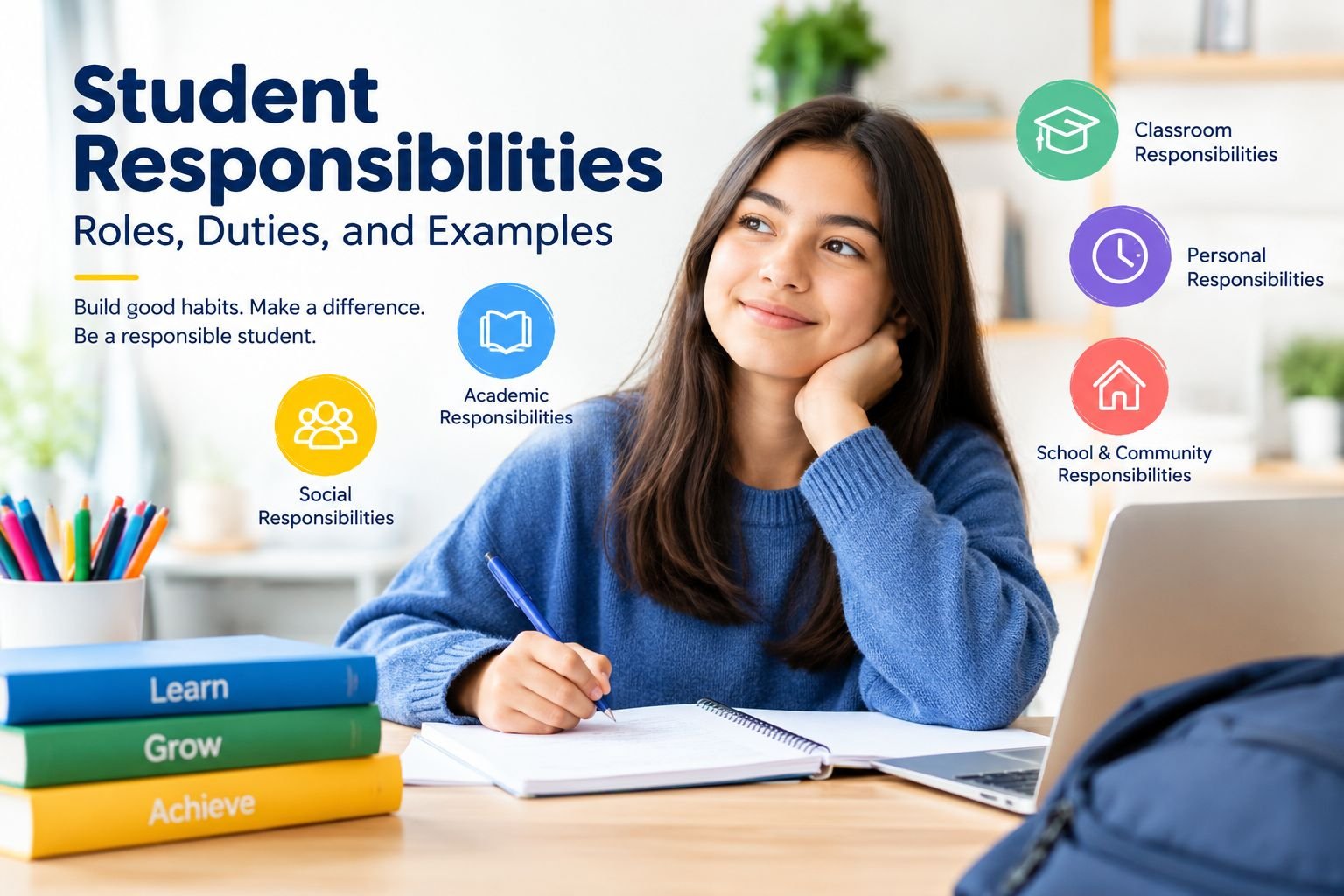
Student Responsibilities: Roles, Duties, and Examples
Being a student involves more than attending school and completing homework. Students have responsibilities toward their learning, teachers, classmates, school, family, and community.
A responsible student takes an active part in learning, manages schoolwork, respects others, follows school expectations, and takes ownership of their actions.
Whether you are a student looking for a simple explanation, a parent helping a child understand their duties, or a teacher looking for classroom guidance, this guide explains the main student responsibilities, their role in school, common duties, and practical examples.
Note: Student responsibilities can vary according to age, school policies, educational systems, and individual circumstances. The examples in this guide describe common responsibilities rather than rules for every school.
Key Takeaways
- Student responsibilities include academic, personal, classroom, social, and school-related duties.
- Students are responsible for taking an active role in their own learning.
- Good attendance, preparation, time management, and participation are important academic responsibilities.
- Respecting teachers, classmates, school staff, and school property is part of being a responsible student.
- Responsibility does not mean being perfect. It means making an effort, accepting mistakes, and learning from them.
- Students can build responsibility through simple habits such as planning their work, staying organized, and asking for help.
What Are Student Responsibilities?
Student responsibilities are the tasks, behaviors, and obligations students are expected to manage as part of their education and school life.
These responsibilities include completing schoolwork, attending classes, participating in lessons, following school expectations, respecting other people, caring for school property, and managing time.
Responsibility also means taking ownership of personal choices. For example, if a student forgets an assignment, being responsible means acknowledging the mistake and finding a way to avoid the same problem in the future.
Definition of Responsibility for Students
For students, responsibility means being accountable for their learning, actions, decisions, and behavior.
In simple words, a responsible student understands what needs to be done and makes a genuine effort to do it.
What Does It Mean to Be a Responsible Student?
Being responsible does not mean getting perfect grades or never making mistakes.
A responsible student may struggle with a subject, forget something, or make a poor decision. The important part is what happens next: the student acknowledges the problem, asks for help when necessary, learns from feedback, and tries to improve.
Responsibility vs. Duty vs. Role
The words responsibility, duty, and role are closely related, but they are not exactly the same.
| Term | Simple Meaning | Student Example |
|---|---|---|
| Responsibility | Something a student should take ownership of | Completing an assignment |
| Duty | A task or obligation a student is expected to perform | Attending a scheduled class |
| Role | The part a student plays in a particular situation | Acting as a class representative |
Understanding these differences makes it easier to describe what students are expected to do at school.
What Are the Main Responsibilities of a Student?
Students have responsibilities in several areas of school and everyday life. The main ones include:
- Attending classes regularly
- Arriving on time
- Coming prepared with necessary materials
- Completing homework and assignments
- Participating in classroom activities
- Listening to teachers and classmates
- Asking questions when something is unclear
- Respecting teachers, classmates, and school staff
- Following school and classroom rules
- Taking care of school property
- Managing time and deadlines
- Staying organized
- Practicing academic honesty
- Working cooperatively with others
- Maintaining healthy daily habits
- Taking responsibility for mistakes
- Helping others when they need support
- Setting realistic learning goals
- Making a consistent effort
- Contributing positively to the school community
These responsibilities can be grouped into academic, classroom, personal, social, and community responsibilities.
Academic Responsibilities of Students
Students have an important role in their own education. Teachers provide instruction and guidance, but students also need to participate actively in the learning process.
Attend Classes Regularly
Regular attendance gives students opportunities to learn new material, participate in activities, ask questions, and receive feedback.
When a student cannot attend, they should follow their school’s process for reporting an absence and finding out what work was missed.
Complete Assignments
Homework, projects, reading, and other assignments give students opportunities to practice what they learn.
Students should understand the instructions, manage their time, complete their own work, and meet deadlines.
Prepare for Tests and Exams
Students should review lessons and prepare for assessments rather than relying entirely on last-minute studying.
Useful habits include reviewing notes, practicing questions, identifying difficult topics, and asking the teacher for clarification.
Participate in Learning
Participation can involve answering questions, joining discussions, completing activities, contributing to group work, or asking thoughtful questions.
A student does not need to know every answer before participating. Asking for clarification is itself an important part of learning.
Ask for Help
Struggling with a lesson is normal. A responsible student recognizes when they need help and seeks it.
Depending on the situation, help may come from a teacher, parent, tutor, classmate, librarian, or another suitable learning resource.
Practice Academic Honesty
Students should represent their own work honestly.
This means avoiding cheating, plagiarism, copying another student’s work, or presenting someone else’s ideas as their own.
Set Learning Goals
Students can set realistic goals that match their age and learning needs.
For example, a student might aim to improve reading comprehension, complete assignments more consistently, improve a particular subject, or develop better study habits.
Responsibilities in the Classroom
A classroom is a shared learning environment. Students play an important role in keeping it productive and respectful.
| Classroom Responsibility | What It Looks Like |
|---|---|
| Be prepared | Bring required books, supplies, and materials |
| Listen | Pay attention when teachers or classmates are speaking |
| Participate | Join discussions and learning activities |
| Ask questions | Speak up when a concept is unclear |
| Follow classroom rules | Observe agreed classroom expectations |
| Respect others | Listen to different opinions and communicate politely |
| Work with classmates | Share tasks and contribute during group work |
| Complete classwork | Finish assigned activities |
| Care for the classroom | Keep shared spaces and materials in good condition |
Listen to Teachers and Classmates
Good listening is an essential classroom skill. Students should pay attention to explanations, instructions, questions, and feedback.
They should also give classmates an opportunity to speak without unnecessary interruptions.
Respect Other Students
Students may have different opinions, cultures, interests, abilities, and learning styles.
Respect means listening to others, communicating politely, and avoiding bullying and harassment.
Participate in Discussions
Students can contribute by answering questions, sharing relevant ideas, asking questions, and responding respectfully to different viewpoints.
Work Cooperatively
Group activities require students to communicate and share responsibilities.
Each student should contribute to the task rather than leaving the work to other group members.
Take Care of the Learning Environment
Students share responsibility for the classroom and its resources.
They should handle books, desks, computers, laboratory equipment, sports equipment, and other school resources carefully.
Personal Responsibilities of Students
School responsibilities are easier to manage when students develop good personal habits.
Manage Time
Students may need to balance classes, homework, studying, extracurricular activities, family responsibilities, hobbies, and rest.
A simple daily or weekly schedule can help students decide what needs to be completed first.
Stay Organized
Students can stay organized by:
- Recording important deadlines.
- Keeping notebooks and folders in order.
- Preparing school materials in advance.
- Maintaining an organized study area.
- Keeping track of upcoming tests and projects.
Maintain Healthy Habits
Students should make time for sleep, nutritious meals, physical activity, recreation, and rest.
A balanced routine can make it easier to manage everyday school responsibilities.
Take Responsibility for Mistakes
Mistakes are part of learning.
Instead of immediately blaming another person, a responsible student can ask:
What happened? What could I have done differently? What can I do now to fix the problem?
This approach turns a mistake into a learning opportunity.
Social Responsibilities of Students
Students interact with teachers, classmates, staff, family members, and other people in their communities.
Treat Others With Respect
Respect means listening to others, using considerate language, recognizing differences, and treating people fairly.
Help Others
Students can support classmates by explaining a difficult concept, welcoming a new student, helping during group activities, or offering encouragement.
Helping someone should not mean completing their work for them. The goal is to support learning and cooperation.
Communicate Clearly
Good communication involves listening carefully, explaining ideas clearly, asking questions, and discussing disagreements calmly.
Handle Disagreements Respectfully
Students will sometimes disagree.
Rather than insulting, threatening, or deliberately excluding someone, students should try to communicate calmly and seek help from a trusted adult when a disagreement cannot be resolved safely.
Responsibilities Toward School Property
Schools provide students with buildings, books, furniture, technology, sports equipment, laboratories, libraries, and other resources.
Students should:
- Handle books and equipment carefully.
- Use technology according to school rules.
- Keep shared areas clean.
- Follow instructions for school facilities.
- Avoid deliberately damaging property.
- Report damage or problems to the appropriate school staff.
Taking care of school property helps ensure that other students can use those resources too.
Responsibilities Toward Teachers and School Staff
Teachers and school staff support students throughout their education.
Students can contribute to a positive learning environment by:
- Listening to instructions.
- Communicating respectfully.
- Completing assigned work.
- Asking questions when they need clarification.
- Following classroom and school expectations.
- Accepting constructive feedback.
- Being honest about difficulties.
- Participating in lessons.
Respect should go both ways: students should be treated with dignity, and they should also treat teachers and staff respectfully.
Responsibilities Toward Parents and Family
Students also have responsibilities at home.
Depending on their age and family circumstances, these may include:
- Communicating honestly about schoolwork.
- Completing homework and study tasks.
- Keeping school materials organized.
- Following family expectations.
- Managing time between school and home activities.
- Respecting family members.
- Asking for help when they need it.
Family expectations differ, so students and parents should communicate clearly about responsibilities.
Responsibilities Toward the Community
Students are members of their communities as well as their schools.
They can contribute by:
- Following community rules.
- Respecting public spaces.
- Taking care of shared property.
- Disposing of waste properly.
- Helping others when possible.
- Participating in suitable community or recreation programs.
- Treating community members respectfully.
These everyday actions help students understand that responsibility extends beyond the classroom.
What Is the Role of a Student?
The role of a student is to participate actively in education, develop knowledge and skills, take responsibility for learning, and contribute positively to the school environment.
Students are not simply recipients of information. They ask questions, practice skills, solve problems, collaborate with others, respond to feedback, and make decisions about how they approach their learning.
Role of a Student in the Classroom
In the classroom, students are expected to:
- Pay attention during lessons.
- Participate in learning activities.
- Ask questions.
- Complete assigned work.
- Cooperate with classmates.
- Follow classroom expectations.
- Take ownership of their learning.
Role of a Student in School
At the school level, students contribute by following school expectations, respecting staff and classmates, participating in school activities, and taking care of shared resources.
Some students may also take additional roles as class representatives, club members, team captains, or student council members.
Role of a Student in Society
Students are developing skills that can help them participate in their communities. Learning to communicate, cooperate, solve problems, respect differences, and take responsibility prepares students for responsibilities beyond school.
What Are the Duties of a Student?
The duties of a student can be summarized simply:
- Attend classes.
- Arrive on time.
- Come prepared.
- Complete schoolwork.
- Participate in lessons.
- Study and prepare for assessments.
- Follow school expectations.
- Respect teachers and classmates.
- Take care of school resources.
- Ask for help when necessary.
- Work honestly.
- Manage time and deadlines.
- Take responsibility for personal actions.
These duties form the foundation of responsible student behavior.
Rights and Duties of Students
Students have both rights and responsibilities. The exact rights and school expectations depend on the educational system, school policies, and applicable laws.
| Student Rights | Related Responsibilities |
|---|---|
| Opportunity to learn | Attend and participate |
| Respectful treatment | Treat others respectfully |
| Opportunity to ask questions | Listen and engage in lessons |
| A suitable learning environment | Follow school expectations |
| Feedback about learning | Use feedback to improve |
| Opportunities to participate | Participate responsibly |
Understanding both sides helps students recognize that school is a shared environment. Students should receive support and respect while also contributing to a positive learning community.
What Makes a Responsible Student?
A responsible student is not necessarily the student with the highest grades.
Responsibility is reflected in everyday choices and habits.
Reliability
A reliable student makes a genuine effort to complete commitments and schoolwork.
Organization
An organized student keeps track of assignments, deadlines, materials, and important information.
Punctuality
Arriving on time helps students make the most of available learning time.
Honesty
Honest students take ownership of their work and communicate truthfully about mistakes or difficulties.
Self-Discipline
Students often need to complete important tasks even when those tasks are not their favorite activity.
Respect
Responsible students communicate respectfully with teachers, classmates, school staff, and other people.
Accountability
Accountability means recognizing the connection between personal choices and their consequences.
Cooperation
Students regularly need to work with other people. Cooperation involves listening, contributing, and sharing responsibilities.
Willingness to Learn
A responsible student accepts that they will not understand everything immediately and remains willing to learn from questions and feedback.
Perseverance
Difficult subjects and challenging assignments are part of education. Students can respond by continuing to work, changing their approach, and asking for assistance.
Student Responsibilities at Different Ages
Responsibilities change as students become more independent.
| School Stage | Examples of Responsibilities |
|---|---|
| Primary School | Bringing supplies, following classroom rules, completing simple homework, caring for belongings |
| Middle School | Managing multiple assignments, organizing materials, studying independently, participating in activities |
| High School | Managing deadlines, preparing for examinations, setting academic goals, making independent study decisions |
| College or University | Managing independent study, meeting deadlines, attending classes, maintaining academic honesty, organizing a larger workload |
Parents and teachers can gradually give students more responsibility as their skills and independence develop.
A Real-Life Example of Student Responsibility
Consider a student named Maya.
Maya has a science project due on Friday. On Monday, she realizes that the project requires more research than she expected.
Instead of waiting until Thursday night, she divides the project into smaller tasks. On Monday, she researches the topic. On Tuesday, she organizes her information. On Wednesday, she creates the project. On Thursday, she checks her work and prepares it for submission.
This example demonstrates several responsibilities at once:
- Planning ahead
- Managing time
- Completing schoolwork
- Breaking a large task into smaller steps
- Checking work before submission
- Taking ownership of a deadline
Being responsible often comes down to small decisions made consistently.
Student Responsibilities in Group Activities
Group work gives students an opportunity to practice communication, cooperation, and accountability.
A responsible group member should:
- Complete their assigned task.
- Listen to other group members.
- Share useful ideas.
- Respect different opinions.
- Communicate clearly.
- Meet agreed deadlines.
- Help solve problems.
- Give credit to other students.
- Contribute fairly to the group’s work.
If a student cannot complete their part, communicating with the group early is better than leaving the problem until the deadline.
Student Council Roles and Responsibilities
Some students take on additional responsibilities through student councils, student government, class representation, clubs, or similar organizations.
Depending on the school’s structure, these roles may involve:
- Representing student ideas or concerns.
- Participating in meetings.
- Helping organize school events.
- Supporting school activities.
- Communicating information to students.
- Working with teachers or administrators on student initiatives.
- Encouraging participation in school programs.
The exact responsibilities depend on the school’s student leadership structure.
20 Simple Examples of Student Responsibilities
Here are practical examples students can use to understand what responsibility looks like in everyday school life:
- Arriving at school on time.
- Bringing required books.
- Completing homework.
- Listening during lessons.
- Asking questions.
- Participating in class.
- Preparing for tests.
- Following classroom rules.
- Respecting teachers.
- Respecting classmates.
- Keeping school materials safe.
- Taking care of school property.
- Meeting assignment deadlines.
- Keeping notes organized.
- Managing study time.
- Working honestly.
- Contributing during group work.
- Helping classmates learn.
- Admitting mistakes.
- Trying to improve.
How Can Students Become More Responsible?
Responsibility is a skill that develops through practice. Students do not have to change everything at once.
1. Create a Daily Schedule
Write down classes, assignments, activities, and important deadlines.
2. Break Large Tasks Into Smaller Steps
A large project can feel easier when divided into several smaller tasks.
3. Use a Homework Checklist
A simple checklist can help students remember assignments and track completed work.
4. Prepare the Night Before
Packing school materials and checking the next day’s schedule can reduce morning stress.
5. Avoid Leaving Everything Until the Last Minute
Starting assignments earlier gives students more time to deal with difficult parts or unexpected problems.
6. Ask for Help
If something is difficult, asking a teacher, parent, or another trusted person for guidance can prevent a small problem from becoming a larger one.
7. Learn From Mistakes
Instead of focusing only on what went wrong, think about what can be changed next time.
8. Review Your Progress
At the end of each week, students can ask themselves:
- What did I complete?
- What did I struggle with?
- What did I learn?
- What should I improve next week?
9. Balance School and Personal Time
Students need time for sleep, family, recreation, hobbies, and physical activity as well as schoolwork.
Student Responsibilities Checklist
Students can use this checklist as a simple daily reminder:
Daily Student Checklist
☐ I attended my classes.
☐ I arrived on time.
☐ I brought the materials I needed.
☐ I listened during lessons.
☐ I participated in class.
☐ I asked for help when I was confused.
☐ I completed my assigned work.
☐ I treated teachers and classmates respectfully.
☐ I took care of school property.
☐ I kept my school materials organized.
☐ I reviewed important work or notes.
☐ I prepared for the next school day.
This checklist can be printed or adapted into a weekly student planner.
Frequently Asked Questions About Student Responsibilities
What are the responsibilities of a student?
The responsibilities of a student include attending classes, preparing for lessons, completing assignments, participating in learning, respecting others, following school expectations, caring for school property, managing time, and taking responsibility for personal actions.
What are the five main responsibilities of a student?
Five important responsibilities are attending classes, completing schoolwork, participating in learning, respecting teachers and classmates, and taking responsibility for personal behavior and decisions.
What are the main duties of a student?
The main duties of a student include attending classes, completing schoolwork, studying, participating in lessons, following school expectations, respecting others, taking care of school resources, and asking for help when needed.
What is the role of a student?
The role of a student is to participate actively in learning, develop knowledge and skills, complete school responsibilities, cooperate with others, and contribute positively to the learning environment.
What does a student do?
A student attends classes, learns new information and skills, completes assignments, participates in activities, works with teachers and classmates, prepares for assessments, and develops academic and personal skills.
What makes a responsible student?
A responsible student is generally reliable, organized, respectful, honest, punctual, cooperative, willing to learn, and prepared to take ownership of their actions.
Why are student responsibilities important?
Student responsibilities help students participate effectively in their education, develop self-management skills, cooperate with others, and gradually become more independent.
What are classroom responsibilities?
Classroom responsibilities include being prepared, listening during lessons, participating in activities, following classroom expectations, respecting others, completing assigned work, and caring for the learning environment.
What are academic responsibilities?
Academic responsibilities include attending classes, completing assignments, studying, participating in lessons, asking questions, preparing for assessments, meeting deadlines, and maintaining academic honesty.
What are the responsibilities of students toward teachers?
Students should listen to teachers, communicate respectfully, follow classroom instructions, complete assigned work, participate in lessons, ask questions when necessary, and respond constructively to feedback.
What are the responsibilities of students toward their school?
Students should follow school expectations, respect teachers and classmates, take care of school property, participate in school activities, and contribute to a positive learning environment.
What are the responsibilities of students in a group?
Students working in groups should complete their assigned tasks, communicate with teammates, listen to different ideas, respect other members, meet deadlines, and contribute fairly.
Conclusion
Student responsibilities are an important part of education. They include much more than completing homework or attending classes.
A responsible student takes an active role in learning, manages schoolwork, respects teachers and classmates, follows school expectations, cares for shared resources, and takes ownership of personal decisions.
Responsibility develops gradually through everyday habits. Planning schoolwork, staying organized, asking for help, meeting deadlines, learning from mistakes, and treating others respectfully can all help students become more responsible.
Most importantly, being a responsible student does not mean being perfect. It means making a genuine effort, recognizing when something needs to change, and continuing to learn and improve.