
40 Hardest Jobs in the World: The Most Difficult Careers Explained
What is the hardest job in the world?
There is no official answer, because “hard” can mean very different things. One career might push the limits of physical endurance, another might expose workers to serious danger, while another requires years of training and the ability to make life-changing decisions under intense pressure.
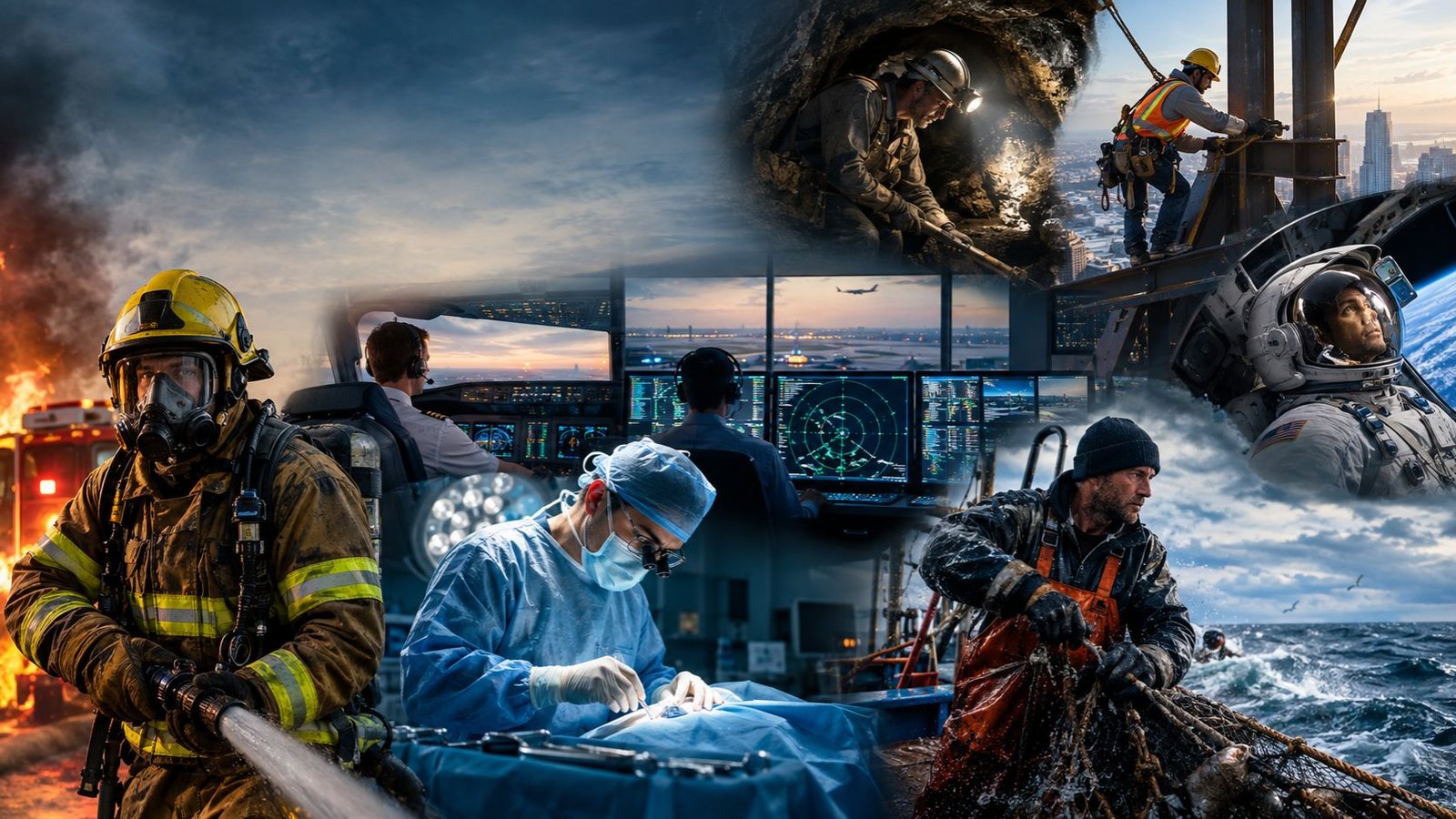
A commercial fisherman can spend long hours at sea dealing with rough weather and heavy equipment. A firefighter may enter a burning building when everyone else is trying to get out. An air traffic controller has to maintain concentration while coordinating aircraft in busy airspace. A surgeon can spend more than a decade preparing for a profession where precision matters enormously.
This list looks at 40 of the world’s most demanding jobs by considering five major factors:
- Physical demands
- Workplace danger
- Mental pressure
- Emotional demands
- Training, responsibility, and working conditions
The ranking is an editorial comparison rather than an official worldwide ranking. A job’s position can change depending on which type of difficulty matters most.
Salary figures in this article are approximate U.S. annual pay ranges intended for comparison. Actual earnings vary by experience, location, employer, specialization, overtime, seniority, and industry.
How We Chose the Hardest Jobs
There is no universal test for measuring whether one occupation is harder than another. Instead, the jobs in this list were considered across several dimensions.
Physical demands
How much strength, stamina, coordination, climbing, lifting, standing, walking, or repetitive movement does the job require?
Danger and environmental exposure
Does the worker face significant risks from heights, machinery, fire, explosives, extreme weather, hazardous substances, vehicles, or remote environments?
Mental pressure
Does the job require constant concentration, rapid decisions, complex problem-solving, or dealing with situations where mistakes can have serious consequences?
Emotional demands
Does the worker regularly encounter trauma, death, vulnerable people, emergencies, conflict, or emotionally difficult situations?
Training and responsibility
How much education, specialist training, licensing, experience, or responsibility is required before someone can perform the job independently?
Working conditions
Long shifts, night work, irregular schedules, isolation, travel, and extended periods away from home can make an otherwise manageable profession considerably harder.
With those factors in mind, here are 40 careers that stand out for their demanding conditions.
40 Hardest Jobs in the World
40. Sanitation Worker
Approximate U.S. annual pay: $30,000–$55,000
Main difficulty: Physical work and exposure
Typical entry path: Employer training and job-specific requirements
Sanitation workers perform one of the most essential jobs in modern society, yet much of their work happens out of public view.
They collect and transport waste, clean public spaces, and handle materials that can be unpleasant, heavy, sharp, contaminated, or hazardous. Much of the work takes place outdoors, so workers can face heat, cold, rain, and other weather conditions.
The physical side of the job is only part of the challenge. Workers also operate around moving collection vehicles and traffic, often while completing repetitive tasks at a demanding pace.
What makes it especially difficult: The work is physically repetitive, exposed to unpleasant materials, and performed in conditions that can be uncomfortable or hazardous.
39. Roofer
Approximate U.S. annual pay: $40,000–$65,000
Main difficulty: Heights and physical endurance
Typical entry path: Apprenticeship or on-the-job training
Roofing combines physical labor with one obvious complication: much of the work happens several feet above the ground.
Roofers carry materials, climb ladders, bend, kneel, stretch, and work on sloped surfaces. Hot roofs can become particularly uncomfortable during summer, while wind and rain can complicate outdoor work.
The job also demands concentration. Installing a roof isn’t simply about moving materials around; workers have to measure, cut, position, and secure materials correctly.
What makes it especially difficult: Physical strain, working at height, weather exposure, and the need for accuracy.
38. Truck Driver
Approximate U.S. annual pay: $45,000–$75,000
Main difficulty: Long hours and sustained concentration
Typical entry path: Commercial driver’s license and required training
Long-haul truck driving can look straightforward from the outside: sit behind the wheel and drive.
The reality is considerably more demanding.
Drivers may spend many hours on the road while monitoring traffic, road conditions, weather, vehicle performance, navigation, and delivery schedules. Fatigue management is an important part of the job, and long-distance routes can mean spending substantial time away from home.
A truck driver is also responsible for controlling a large, heavy vehicle in constantly changing traffic conditions.
What makes it especially difficult: Prolonged concentration, fatigue, isolation, traffic, irregular schedules, and time away from family.
37. Brick Mason
Approximate U.S. annual pay: $45,000–$70,000
Main difficulty: Repetitive physical work and precision
Typical entry path: Apprenticeship or practical training
Brick masons build walls, foundations, chimneys, and other structures using brick, block, stone, and mortar.
The work requires repeatedly lifting and positioning materials while bending, kneeling, reaching, and standing for long periods.
At the same time, masonry requires precision. Walls need to be properly aligned and materials need to be positioned accurately. Physical strength alone isn’t enough.
What makes it especially difficult: Heavy materials, repetitive movements, outdoor conditions, and the combination of strength with precision.
36. Logger
Approximate U.S. annual pay: $40,000–$65,000
Main difficulty: Physical danger and unpredictable terrain
Typical entry path: On-the-job training and equipment experience
Logging is one of those careers where the work environment itself becomes part of the challenge.
Loggers work around trees, chainsaws, heavy machinery, uneven ground, falling branches, and changing weather. They need to understand equipment and constantly assess their surroundings.
A forest isn’t a controlled workplace like an office or factory floor. Terrain changes, trees behave unpredictably, and weather can affect working conditions.
What makes it especially difficult: Heavy machinery, falling objects, difficult terrain, physical labor, and an unpredictable outdoor environment.
35. Scaffolder
Approximate U.S. annual pay: $40,000–$70,000
Main difficulty: Heights and construction hazards
Typical entry path: Practical training, certification, and site-specific requirements
Scaffolders build temporary structures that allow other construction workers to work safely at height.
That makes accuracy particularly important. A scaffold must be assembled correctly, secured properly, and inspected according to applicable safety requirements.
Workers also have to move heavy components and work in elevated positions, sometimes in windy, cold, or wet conditions.
What makes it especially difficult: Working at height while handling heavy components where precision directly affects safety.
34. Miner
Approximate U.S. annual pay: $50,000–$85,000
Main difficulty: Physical work and hazardous environments
Typical entry path: Employer training, technical training, or specialized qualifications
Mining has changed significantly with modern technology, but many mining occupations remain demanding.
Underground workers can operate in confined spaces around machinery, dust, noise, vibration, and difficult terrain. Surface mining presents a different set of physical and equipment-related challenges.
Miners also need to understand safety procedures, equipment, ventilation, communication systems, and emergency protocols.
What makes it especially difficult: A combination of physical labor, industrial machinery, confined environments, and environmental hazards.
33. Oil and Gas Worker
Approximate U.S. annual pay: $50,000–$100,000+
Main difficulty: Industrial hazards and long shifts
Typical entry path: Employer training, technical qualifications, or industry experience
Oil and gas operations bring workers into large industrial environments involving machinery, pressure systems, chemicals, and complex equipment.
Some workers also operate in remote locations where they may be separated from their families for extended periods.
The industry includes many different occupations, so difficulty varies considerably between roles. Drilling and production positions, for example, can be substantially different from administrative or technical office jobs.
What makes it especially difficult: Long shifts, industrial hazards, remote locations, and physically demanding work in some roles.
32. Construction Worker
Approximate U.S. annual pay: $40,000–$70,000
Main difficulty: Physical demands and changing environments
Typical entry path: On-the-job training, apprenticeship, or trade qualifications
Construction workers may spend their days lifting materials, digging, climbing, operating equipment, assembling structures, or performing specialized tasks.
Construction sites are constantly changing. Workers may have to coordinate with multiple trades while dealing with machinery, heights, uneven surfaces, weather, and deadlines.
The physical requirements also vary dramatically depending on the specialty.
What makes it especially difficult: Heavy physical work combined with changing environments and multiple workplace hazards.
31. Farmer
Approximate U.S. annual pay: Highly variable
Farming is difficult partly because farmers have limited control over some of the factors that determine their success.
Weather, drought, storms, pests, disease, equipment failures, market prices, and supply costs can all affect operations.
Farmers may also work long days during planting and harvest seasons while handling machinery, livestock, crops, maintenance, finances, and business decisions.
What makes it especially difficult: It combines physical work with unpredictable environmental and financial pressures.
30. Commercial Fisherman
Approximate U.S. annual pay: Highly variable
Commercial fishing combines several types of difficulty that rarely appear together in ordinary jobs.
Workers can spend long periods at sea operating in wet, cold, unstable conditions. Heavy equipment, slippery surfaces, large catches, ropes, nets, and machinery can turn ordinary tasks into physically demanding work.
The biggest difference from many land-based occupations is distance. When a problem occurs far offshore, immediate help may not be available.
What makes it especially difficult: Physical labor, unpredictable weather, isolation, long shifts, and a challenging marine environment.
29. Mountain Guide
Approximate U.S. annual pay: $35,000–$70,000+, depending on specialty
Mountain guides aren’t simply experienced hikers. They may be responsible for helping other people navigate difficult terrain and make safe decisions in rapidly changing conditions.
Depending on the environment, the job can involve steep rock, snow, glaciers, altitude, extreme cold, and difficult navigation.
A guide has an additional responsibility: the people accompanying them may have less experience with the environment.
What makes it especially difficult: Physical endurance combined with navigation skills and responsibility for other people’s safety.
28. Cell Tower Technician
Approximate U.S. annual pay: $45,000–$80,000
Main difficulty: Height and technical work
Typical entry path: Technical training and safety qualifications
Cell tower technicians work high above the ground installing, maintaining, and repairing telecommunications equipment.
The height alone makes this profession unusual. Workers must climb, secure equipment, handle tools, and maintain concentration while operating in an elevated environment.
Weather and electrical hazards can add further complications.
What makes it especially difficult: Extreme heights combined with technical work and exposure to weather and electrical hazards.
27. Ironworker
Approximate U.S. annual pay: $50,000–$90,000
Main difficulty: Heavy materials and working at height
Typical entry path: Apprenticeship or trade training
Ironworkers help build the structural framework of buildings, bridges, and other major projects.
They work with heavy steel components, cranes, tools, and specialized equipment. Some tasks are performed high above the ground.
The job requires strength, balance, coordination, and an understanding of construction procedures.
What makes it especially difficult: Heavy steel, elevated work, precision, physical strength, and coordination.
26. Paramedic
Approximate U.S. annual pay: $40,000–$75,000
Main difficulty: Emergency decisions and emotional pressure
Typical entry path: Emergency medical education and certification/licensing
Paramedics don’t have the luxury of knowing what their next call will involve.
They may arrive at vehicle crashes, cardiac emergencies, injuries, fires, overdoses, or other critical situations. They have to assess patients quickly and begin appropriate treatment, sometimes in locations that aren’t designed for medical care.
They also interact with frightened patients, relatives, witnesses, and other emergency personnel.
What makes it especially difficult: High-stakes medical decisions in unpredictable environments.
25. Search and Rescue Worker
Approximate U.S. annual pay: Varies significantly by organization and specialty
Search and rescue teams may work in mountains, forests, oceans, disaster zones, caves, or remote areas.
Their job can begin when someone else is already in serious trouble. The team then has to locate the person, assess the environment, reach them, and bring them to safety.
Physical fitness is important, but so are navigation, teamwork, communication, first aid, and decision-making.
What makes it especially difficult: The worker often enters an environment specifically because someone else could not safely get out of it.
24. Correctional Officer
Approximate U.S. annual pay: $45,000–$75,000
Main difficulty: Security and conflict management
Typical entry path: Employer requirements and specialized training
Correctional officers work inside prisons and other correctional facilities, maintaining security and enforcing institutional rules.
The environment requires constant awareness. Officers may have to respond to conflicts, emergencies, medical situations, or attempts to violate facility rules.
Communication is also a major part of the profession. Maintaining order isn’t simply about physical strength; officers need to make decisions and manage interactions professionally.
What makes it especially difficult: Unpredictable situations, conflict, security responsibility, and shift work.
23. Police Officer
Approximate U.S. annual pay: $55,000–$90,000
Main difficulty: Unpredictability and public safety
Typical entry path: Academy training and jurisdiction-specific requirements
Police work is difficult partly because officers rarely know exactly what a shift will bring.
A day can involve routine administrative work followed by an emergency requiring immediate action. Officers may deal with accidents, disputes, crimes, missing people, and potentially dangerous situations.
The job also requires communication and judgment. Physical capability is important, but knowing how to respond appropriately to different situations is equally important.
What makes it especially difficult: Unpredictability, responsibility, physical risk, and high-pressure decision-making.
22. Firefighter
Approximate U.S. annual pay: $50,000–$90,000
Main difficulty: Physical danger and emergency response
Typical entry path: Fire academy and relevant certifications
Firefighters do much more than fight fires.
Modern fire departments respond to vehicle crashes, medical emergencies, hazardous materials incidents, rescues, natural disasters, and other emergencies.
Fire scenes can involve intense heat, smoke, unstable structures, limited visibility, and rapidly changing conditions.
Firefighters must also maintain physical fitness and train repeatedly so that procedures become familiar before an emergency occurs.
What makes it especially difficult: It combines physical exertion, danger, teamwork, technical training, and emergency decision-making.
21. Military Service Member
Approximate U.S. annual pay: Varies by rank, service, and assignment
Main difficulty: Physical, psychological, and operational demands
Typical entry path: Military recruitment and training
Military service includes hundreds of different occupations, so not every service member faces the same challenges.
However, military careers can involve rigorous training, strict discipline, relocation, long periods away from family, irregular schedules, and deployment.
Combat-related roles add substantially different risks and demands.
What makes it especially difficult: The combination of physical requirements, discipline, mobility, operational demands, and separation from normal civilian life.
20. Combat Engineer
Approximate U.S. annual pay: Varies by rank and military service
Main difficulty: Engineering under operational conditions
Typical entry path: Military training and specialist instruction
Combat engineers combine technical engineering tasks with military operations.
Their work can include constructing defensive positions, improving routes, building bridges, removing obstacles, and performing demolition-related tasks.
The environment can be very different from civilian construction. Tasks may need to be completed under operational pressure and potentially dangerous conditions.
What makes it especially difficult: Technical expertise and physical work performed under military conditions.
19. Explosive Ordnance Disposal Specialist
Approximate U.S. annual pay: Varies by military service, rank, and assignment
Main difficulty: Precision and extreme consequences
Typical entry path: Specialized military selection and training
Explosive ordnance disposal specialists are trained to identify, assess, and deal with explosive hazards.
The defining challenge isn’t simply courage. It is precision.
Procedures must be followed carefully, information must be evaluated, and decisions may have serious consequences. The job requires extensive training and the ability to remain focused in highly stressful circumstances.
What makes it especially difficult: Specialized knowledge, precision, dangerous materials, and very little room for careless decisions.
18. Air Traffic Controller
Approximate U.S. annual pay: $80,000–$160,000+
Main difficulty: Sustained concentration
Typical entry path: Specialized selection and training
Air traffic controllers work in an environment where concentration is essential.
They monitor aircraft, communicate with pilots, coordinate movements, and respond when traffic conditions change.
The challenge isn’t necessarily physical. It is cognitive. Controllers have to process information continuously and communicate clearly, often while managing multiple aircraft and changing circumstances.
The work can also involve shifts outside conventional daytime hours.
What makes it especially difficult: Constant attention, complex information processing, precise communication, and high responsibility.
17. Airline Pilot
Approximate U.S. annual pay: $100,000–$250,000+ for experienced airline pilots
Main difficulty: Training, responsibility, and decision-making
Typical entry path: Extensive flight training, certifications, and required flight experience
Flying a modern passenger aircraft is highly technical.
Pilots must understand aircraft systems, weather, navigation, communication, regulations, and emergency procedures. Automation handles many routine tasks, but pilots remain responsible for managing the flight and responding appropriately when circumstances change.
The career also comes with an unusual lifestyle. Pilots can work irregular schedules, cross multiple time zones, and spend significant periods away from home.
What makes it especially difficult: Years of training followed by a career where concentration, technical knowledge, and responsibility remain essential.
16. Offshore Oil Rig Worker
Approximate U.S. annual pay: $50,000–$120,000+ depending on role
Main difficulty: Isolation and industrial conditions
Typical entry path: Technical training and employer-specific qualifications
Working offshore means the workplace itself can be far from ordinary.
Employees may live on an offshore facility for extended rotations and work around heavy machinery, industrial systems, chemicals, and energy infrastructure.
The isolation also matters. Workers aren’t simply commuting home at the end of a shift. They live where they work for the duration of their rotation.
What makes it especially difficult: Remote living, long shifts, industrial hazards, and extended time away from home.
15. Ship Captain
Approximate U.S. annual pay: $60,000–$150,000+
Main difficulty: Responsibility and unpredictable conditions
Typical entry path: Maritime education, sea experience, and licensing
A ship captain has responsibility that extends beyond steering a vessel.
Depending on the type of ship, the captain may oversee crew, navigation, cargo, safety procedures, communication, and emergency response.
Weather can change rapidly, mechanical problems can occur, and a vessel may be hundreds of miles from shore.
What makes it especially difficult: Responsibility for people and a vessel while operating in an environment that cannot be controlled.
14. Emergency Room Nurse
Approximate U.S. annual pay: $65,000–$110,000
Main difficulty: Emotional pressure and unpredictable workload
Typical entry path: Nursing education and professional licensure
Emergency nursing is fundamentally different from caring for patients in a predictable environment.
Patients can arrive with serious injuries, sudden illnesses, severe pain, or life-threatening conditions. Nurses must assess patients, administer treatments, monitor changes, communicate with physicians, and support families.
The emotional side can be just as demanding as the medical work.
What makes it especially difficult: High patient turnover, urgent decisions, long shifts, and repeated exposure to serious illness and injury.
13. Child Protection Social Worker
Approximate U.S. annual pay: $50,000–$75,000
Main difficulty: Emotional burden and difficult decisions
Typical entry path: Social work education and relevant licensing requirements
Child protection social workers deal with situations involving vulnerable children and families.
Their work may involve investigating allegations of abuse or neglect, assessing living conditions, coordinating services, documenting cases, and working with other agencies.
The difficult part isn’t simply the workload. It is the emotional weight of dealing with situations where a child’s safety may be at issue.
What makes it especially difficult: Emotionally challenging cases, difficult conversations, complex decisions, and responsibility for vulnerable people.
12. Emergency Physician
Approximate U.S. annual pay: $250,000–$400,000+
Main difficulty: Medical complexity and time pressure
Typical entry path: Medical school, residency, and professional licensing
Emergency physicians work without the predictability of scheduled medicine.
Patients arrive with symptoms ranging from minor injuries to life-threatening conditions. Doctors must quickly determine which cases require immediate attention and what treatment is appropriate.
The combination of uncertainty and time pressure makes emergency medicine particularly demanding.
What makes it especially difficult: Complex medical decisions must often be made quickly with incomplete information.
11. Surgeon
Approximate U.S. annual pay: $300,000–$600,000+ depending on specialty
Main difficulty: Precision, training, and responsibility
Typical entry path: Medical school, residency, licensing, and specialty training
Surgery is difficult before the first operation even begins.
Becoming a surgeon requires years of education and supervised clinical training. Once practicing, surgeons may spend hours performing procedures that demand concentration, technical skill, teamwork, and precision.
There is also little room for distraction. A surgical procedure can require sustained focus from beginning to end.
What makes it especially difficult: A long training pathway followed by technically demanding work with significant responsibility for patients.
The 10 Hardest Jobs in the World
The following ten occupations stand out because they combine several forms of difficulty rather than relying on a single factor.
10. Commercial Fisherman
Commercial fishing combines physical exhaustion, dangerous equipment, rough weather, isolation, and long periods at sea.
Few conventional workplaces are as dependent on nature. The ocean determines conditions, and workers have to adapt to it rather than control it.
9. Miner
Mining combines physical labor with complex industrial equipment and difficult working environments.
Underground operations can be particularly challenging because workers operate in confined environments far from the surface.
8. Firefighter
Firefighters face emergencies in environments that can change within minutes.
Heat, smoke, unstable structures, limited visibility, and physical exertion make firefighting one of the clearest examples of a job that is difficult in several ways simultaneously.
7. Paramedic
Paramedics have to bring medical decision-making into uncontrolled environments.
They can arrive at an emergency without knowing exactly what happened, what injuries are present, or what complications they will encounter.
6. Military Combat Specialist
Combat-related military roles combine physical preparation, technical skills, discipline, uncertainty, and potentially life-threatening conditions.
The demands also extend beyond the workplace because military service can involve deployment and prolonged separation from family.
5. Air Traffic Controller
Air traffic control illustrates a different kind of difficulty.
The worker may not perform heavy physical labor, but the cognitive demands can be intense. Controllers must maintain concentration, process information, communicate accurately, and manage changing traffic situations.
4. Airline Pilot
Professional aviation requires extensive training and continuing proficiency.
Pilots are responsible for aircraft, passengers, crew, navigation, communication, and responding appropriately to abnormal situations.
The lifestyle itself can also be demanding because of irregular schedules and time away from home.
3. Emergency Physician
Emergency physicians combine advanced medical knowledge with the need to make rapid decisions.
They don’t have the luxury of knowing exactly which patients will arrive or what complications the next case will involve.
2. Surgeon
Surgeons face an unusual combination of challenges: extensive training, technical precision, long procedures, demanding schedules, and significant responsibility for patient care.
The difficulty exists both before entering the profession and throughout the career.
1. Astronaut
Astronauts represent an unusually broad combination of professional demands.
Becoming an astronaut typically requires advanced education or highly specialized professional experience, rigorous physical preparation, technical competence, and exceptional selection standards.
Spaceflight adds another dimension. Astronauts operate in a highly controlled but unforgiving environment where normal conditions on Earth no longer apply.
They must understand complex spacecraft systems, conduct scientific or technical tasks, work closely with a small crew, and be prepared for emergencies in an environment where outside assistance cannot arrive quickly.
Why it stands out: Astronauts combine extensive training, physical preparation, technical expertise, isolation, psychological demands, and an exceptionally unusual working environment.
But is an astronaut really the hardest job?
Not necessarily.
The ranking reflects the combination of factors considered in this article, not an objective worldwide measurement.
If you measure physical exhaustion, commercial fishing or logging may rank much higher. If you measure mental concentration, air traffic control may be harder. If you measure emotional exposure, emergency healthcare and child protection work present different challenges.
That is why there is no scientifically established single hardest job on Earth.
Hardest Jobs by Type of Difficulty
Instead of asking only which job is hardest overall, it can be more useful to ask what kind of hard work you’re talking about.
| Type of difficulty | Examples of demanding careers |
|---|---|
| Physical endurance | Logger, miner, construction worker, commercial fisherman |
| Dangerous environment | Commercial fisherman, firefighter, logger, miner |
| Mental concentration | Air traffic controller, pilot, surgeon |
| Emotional pressure | Paramedic, emergency nurse, social worker |
| Extensive training | Surgeon, physician, pilot, astronaut |
| Isolation | Offshore worker, ship captain, astronaut |
| Unpredictability | Paramedic, firefighter, police officer |
| Responsibility for lives | Surgeon, pilot, air traffic controller, emergency physician |
| Working at height | Roofer, scaffolder, ironworker, tower technician |
| Long or irregular schedules | Truck driver, nurse, pilot, offshore worker |
Hardest Jobs Physically
If physical endurance is your definition of a difficult job, look closely at:
- Commercial fishing
- Logging
- Mining
- Construction
- Roofing
- Ironworking
- Firefighting
- Farming
These occupations can require strength, endurance, balance, repetitive movement, or extended periods of physical activity.
Hardest Jobs Mentally
Mental difficulty is different from physical exhaustion.
Careers that can require sustained concentration and complex decisions include:
- Air traffic controller
- Surgeon
- Emergency physician
- Airline pilot
- Astronaut
- Emergency dispatcher
- Scientist
These jobs may involve little heavy lifting, but the cognitive demands can be substantial.
Hardest Jobs Emotionally
Emotional difficulty often comes from repeatedly witnessing situations most people encounter only rarely.
Examples include:
- Paramedics
- Emergency nurses
- Emergency physicians
- Child protection social workers
- Crisis professionals
- Morticians
- Some law enforcement professionals
For these workers, the difficult part may be carrying the emotional consequences of what they see and experience.
Most Dangerous Jobs
Danger and difficulty aren’t identical, but several occupations regularly involve significant workplace hazards.
These include:
- Commercial fishermen
- Loggers
- Miners
- Roofers
- Construction workers
- Firefighters
- Certain military personnel
- Offshore industrial workers
Risk varies considerably between specific jobs, employers, locations, equipment, and safety practices, so “most dangerous” should always be tied to a particular measure and period.
Hardest Jobs That Pay Well
Some demanding careers also offer high earning potential.
| Career | Why it is demanding | Approximate U.S. annual pay |
|---|---|---|
| Surgeon | Precision, training, patient responsibility | $300,000–$600,000+ |
| Emergency physician | High-pressure medical decisions | $250,000–$400,000+ |
| Airline pilot | Technical skill and safety responsibility | $100,000–$250,000+ |
| Air traffic controller | Constant concentration | $80,000–$160,000+ |
| Offshore specialist | Remote and industrial environment | $50,000–$120,000+ |
| Ship captain | Crew, vessel, and navigation responsibility | $60,000–$150,000+ |
A high salary does not necessarily mean a job is harder.
Pay is influenced by education requirements, scarcity of skills, experience, industry economics, location, seniority, overtime, and other factors.
Likewise, a physically exhausting or dangerous occupation can pay considerably less than a highly specialized professional career.
Hardest Jobs That Don’t Require a College Degree
A difficult career doesn’t automatically require a university education.
Some demanding occupations can be entered through apprenticeships, trade schools, licensing, certifications, or employer-based training.
Examples include:
Commercial Fisherman
Experience, safety knowledge, maritime training, and practical skills can be important.
Logger
Workers need equipment knowledge, safety training, and practical experience.
Roofer
Many roofing careers use apprenticeship or on-the-job training pathways.
Construction Worker
Construction offers numerous routes through apprenticeships and specialized trade training.
Truck Driver
Commercial driving generally requires the appropriate license and training rather than a traditional four-year degree.
Scaffolder
Practical training and knowledge of construction safety are central to the work.
Some Mining Occupations
Requirements vary by role, but employers can provide specialized technical and safety training.
A career that doesn’t require a college degree isn’t necessarily easy. Skilled trades can demand considerable physical ability, technical knowledge, experience, and safety awareness.
What Are the Hardest Jobs to Get?
There is an important difference between hard to get and hard to do.
A job can be physically exhausting but relatively accessible to new workers. Another career can be comfortable physically but extremely difficult to enter because of education, licensing, selection, or competition.
Careers that can have demanding entry requirements include:
- Astronaut
- Surgeon
- Specialist physician
- Airline pilot
- Air traffic controller
- Certain military specialties
- Highly specialized scientific and technical positions
The difficulty of entry can depend on the number of available positions, education requirements, licensing rules, experience requirements, and the standards used by individual employers.
Why Are Some Difficult Jobs Highly Paid?
It is tempting to assume that the harder the job, the higher the salary.
In reality, compensation works differently.
A job’s pay can be influenced by:
- Education requirements
- Specialized skills
- Licensing
- Experience
- Labor supply
- Industry demand
- Geographic location
- Working hours
- Seniority
- Overtime
- Employer
- Responsibility
For example, surgery requires years of education and specialized training, which helps explain why experienced surgeons can command high incomes.
By contrast, some physically demanding occupations require less formal education and may therefore have lower average compensation despite demanding working conditions.
Does danger always mean higher pay?
No.
Some dangerous occupations are well compensated, but risk by itself does not determine salary.
A worker’s earnings depend on the labor market surrounding the occupation, required skills, supply and demand, experience, location, and many other factors.
What Makes a Job Truly Difficult?
The hardest jobs usually aren’t difficult for just one reason.
Consider a firefighter.
The job requires physical strength, technical knowledge, teamwork, emergency decision-making, and emotional control.
Now consider an air traffic controller.
The physical demands are very different, but the concentration, communication, and responsibility can be intense.
A surgeon faces yet another type of challenge: years of education followed by highly precise work where decisions can have major consequences.
This shows why comparing careers solely by danger, salary, or physical effort can produce misleading conclusions.
A better question is:
What type of difficulty does this career demand every day?
Are the Hardest Jobs Worth It?
There is no universal answer.
A demanding career may be highly rewarding for one person and completely unsuitable for another.
Potential advantages
Some difficult careers can offer:
- Higher earning potential
- Specialized professional skills
- Career advancement
- Job variety
- A strong sense of purpose
- Opportunities to help others
- Professional recognition
- Personal satisfaction
Potential disadvantages
They can also involve:
- Long working hours
- Physical fatigue
- Workplace hazards
- Emotional stress
- Irregular schedules
- Expensive or lengthy training
- Time away from family
- Difficult working environments
The best career decision depends on more than salary or prestige.
How to Choose a Challenging Career
If you’re attracted to demanding careers, first decide what kind of challenge you actually want.
1. Decide whether you prefer physical or mental challenges
Would you rather spend your day moving, building, climbing, or operating equipment?
Or would you prefer problem-solving, analysis, communication, or decision-making?
2. Look beyond the job title
“Pilot,” “nurse,” “engineer,” or “military professional” can describe many different jobs.
Read actual job descriptions and investigate what workers do during an ordinary shift.
3. Check the training pathway
Find out:
- How long training takes
- Whether a degree is required
- Whether a license is required
- Whether apprenticeships are available
- How much practical experience is needed
4. Consider lifestyle
Think about:
- Working hours
- Night shifts
- Travel
- Time away from home
- Weekends and holidays
- Relocation requirements
5. Compare compensation realistically
Don’t focus only on the highest possible salary.
Consider entry-level pay, training costs, overtime, benefits, location, and how long it takes to reach senior positions.
6. Learn about the risks
Understand the actual working environment before choosing a dangerous occupation.
A career that looks exciting in a video may feel very different when experienced every day.
7. Talk to people who actually do the job
One of the best ways to understand a difficult career is to hear from people working in it.
Ask what they enjoy, what they dislike, what surprised them, and what they wish they had known before starting.
Frequently Asked Questions About the Hardest Jobs in the World
What is the hardest job in the world?
There is no universally accepted answer. Astronauts, surgeons, commercial fishermen, firefighters, air traffic controllers, military personnel, and emergency medical professionals face very different forms of difficulty.
What is the most difficult job in the world?
The answer depends on how difficulty is measured. Physical labor, danger, mental concentration, emotional pressure, training, and responsibility can all produce a different answer.
What are the hardest jobs in the world?
Some of the world’s most demanding careers include commercial fishing, logging, mining, firefighting, paramedicine, military combat roles, air traffic control, aviation, emergency medicine, surgery, and spaceflight.
What is the toughest job in the world?
There isn’t one universally recognized toughest job. The toughest career for one person may not be the toughest for another because people have different physical abilities, interests, skills, and tolerance for particular working conditions.
What are the hardest occupations?
Hard occupations can be found in construction, emergency services, healthcare, transportation, mining, commercial fishing, military service, aviation, maritime work, and several skilled trades.
What is the hardest job physically?
Commercial fishing, logging, mining, construction, roofing, farming, firefighting, and ironworking can involve substantial physical demands. The exact level varies according to the role and workplace.
What is the most mentally challenging job?
Jobs such as air traffic control, surgery, emergency medicine, aviation, and certain scientific or technical professions can require sustained concentration and complex decision-making.
What is the most dangerous job?
There is no single answer for every country or year. Occupational danger depends on how risk is measured and which specific occupation is being examined.
What is the hardest job to get?
Highly specialized careers such as astronaut, surgeon, specialist physician, professional pilot, and certain military positions can have demanding education, training, selection, or licensing requirements.
What are the hardest jobs that pay well?
Examples include surgery, emergency medicine, professional aviation, air traffic control, and certain offshore or maritime careers. Actual salaries vary by experience, location, employer, specialization, and seniority.
What are the hardest jobs without a degree?
Depending on the occupation and location, examples can include commercial fishing, logging, roofing, construction, truck driving, scaffolding, and some mining jobs. Many still require training, licenses, certifications, or substantial experience.
What makes a career difficult?
A career can be difficult because of physical demands, danger, mental concentration, emotional exposure, long hours, extensive training, unpredictable conditions, isolation, or responsibility for other people’s safety.
Salary and Data Note
Salary figures in this article are presented as broad U.S. ranges rather than exact promises of what an individual worker will earn.
Pay can differ significantly based on:
- State and city
- Experience
- Education
- Employer
- Industry
- Seniority
- Specialization
- Overtime
- Union status
- Type of assignment
For a career decision, readers should always check the latest occupational salary information for their country and specific occupation rather than relying on a single national average.
Suggested Visuals for This Article
A long listicle like this can be easier to understand with a few useful visuals.
Visual 1: Hardest Jobs Comparison Chart
Create a horizontal chart comparing the major difficulty dimensions:
Physical | Danger | Mental | Emotional | Training
Use selected occupations such as:
- Commercial fisherman
- Firefighter
- Air traffic controller
- Surgeon
- Pilot
- Astronaut
Visual 2: Hardest Jobs by Category
Create an infographic showing:
Physical → Dangerous → Mental → Emotional → Highly Specialized
and place representative careers beneath each category.
Visual 3: Salary Comparison
Create a bar chart showing approximate U.S. annual pay for selected high-paying demanding careers such as:
- Surgeon
- Emergency physician
- Airline pilot
- Air traffic controller
- Ship captain
- Offshore worker
Clearly label the chart as approximate and identify the data year when publishing.
Visual 4: Career Difficulty Matrix
A simple two-axis graphic can compare:
Physical difficulty on one axis
Mental/emotional difficulty on the other.
This would visually demonstrate why there isn’t one universally hardest occupation.
Final Thoughts
The world’s hardest jobs aren’t necessarily the most dangerous, the highest paying, or the most physically exhausting.
Difficulty comes in many forms.
A commercial fisherman battles the ocean. A logger works around powerful machinery and unpredictable terrain. A firefighter enters dangerous environments during emergencies. A paramedic makes urgent medical decisions before reaching a hospital. An air traffic controller maintains intense concentration. A surgeon spends years training for highly precise work. An astronaut operates in an environment where ordinary assumptions about life on Earth no longer apply.
So, what is the hardest job in the world?
There isn’t one answer that applies to everyone.
If you measure physical endurance, the answer may look very different from a ranking based on mental concentration. If you measure emotional difficulty, healthcare and social services may stand out. If you measure training and professional responsibility, highly specialized careers become much more demanding.
The most useful way to understand the world’s hardest jobs is therefore not to ask which job is hardest overall, but what makes each career difficult—and whether that particular challenge is right for you.