
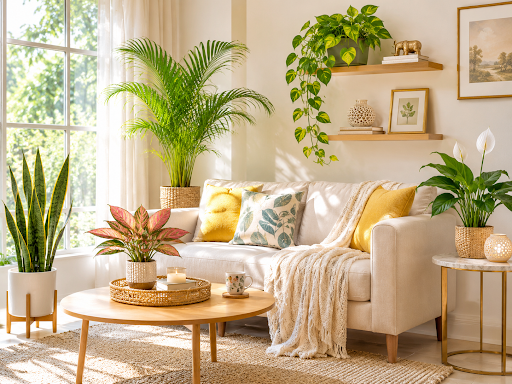
Which Indoor Plants to Consider for Air Quality?
Indoor plants do more than make your home look beautiful.
They bring greenery into your living space, add a natural touch to your interiors, and can make rooms feel more refreshing and welcoming. If you want to add more greenery to your home, choosing the best indoor plants for air quality is a good place to start. Let’s explore 6 of the best options to shop for air-purifying plants.
6 Best Indoor Plants for Air Quality
Here are 6 popular indoor plants for air quality that can add greenery to your home while helping create a more pleasant indoor environment.
1. Snake Plant (Sansevieria)
The Snake Plant is one of the most popular indoor plants for air purification because it is attractive, hardy, and requires very little maintenance. Its upright, sword-shaped leaves look beautiful in living rooms, bedrooms, and office corners.
Snake Plants have also been studied for their ability to absorb certain volatile organic compounds (VOCs) in controlled environments. This makes them a popular choice among people searching for the best indoor plants for air purification.
Benefits:
- Adds greenery without taking up much floor space.
- Tolerates low-light conditions.
- Has low watering requirements.
- Can absorb certain airborne compounds under controlled conditions.
Best placement: Bedroom corners, living rooms, and office spaces.
Note: Snake Plants are toxic to cats and dogs if chewed.
2. Areca Palm (Dypsis lutescens)
The Areca Palm is a beautiful indoor plant with long, arching, feather-like leaves. It adds a tropical feel to indoor spaces and works particularly well in larger living rooms and open corners.
It is frequently included in lists of air purifier plants for home because research has examined its ability to remove certain airborne compounds in controlled settings. Its leafy appearance also makes it an excellent decorative addition.
Benefits:
- Creates a lush, tropical indoor look.
- Adds natural greenery to large rooms.
- Pet-friendly compared with several popular houseplants.
- Can be studied for VOC removal under controlled conditions.
Best placement: Living rooms, spacious bedrooms, and near bright windows.
3. Spider Plant (Chlorophytum comosum)
The Spider Plant is an excellent option for beginners who want an attractive and easy-to-grow houseplant. Its long, narrow leaves feature green and white stripes, while mature plants produce small baby plants called spiderettes.
Spider Plants have been studied for their ability to remove certain airborne pollutants in laboratory environments. They are also relatively easy to propagate, so you can grow new plants from the baby shoots.
Benefits:
- Easy to grow and propagate.
- Suitable for hanging baskets and shelves.
- Non-toxic to cats and dogs.
- Tolerates a range of indoor conditions.
Best placement: Hanging baskets, balconies with filtered light, and living room shelves.
4. Peace Lily (Spathiphyllum)
If you want a flowering indoor plant, the Peace Lily is a lovely choice. Its dark green leaves and elegant white flowers add a graceful touch to indoor spaces.
Peace Lilies have been included in laboratory research on indoor plants and VOC removal. They are also popular among indoor gardeners because they can grow in relatively low-light conditions, although brighter indirect light generally encourages better flowering.
Benefits:
- Produces attractive white flowers.
- Grows well in bright or moderate indirect light.
- Adds a decorative touch to bedrooms and living rooms.
- Has been studied for absorbing certain VOCs.
Best placement: Living rooms, shaded corners, and areas with indirect light.
Note: Peace Lilies are toxic to cats and dogs if ingested.
5. Money Plant (Epipremnum aureum)
The Money Plant, also known as Golden Pothos, is one of the easiest indoor plants to grow. Its heart-shaped leaves and trailing stems make it a popular choice for decorating shelves, tabletops, and hanging planters.
It is also one of the commonly discussed indoor air-purifying plants because studies have examined its ability to absorb certain airborne compounds in controlled environments.
Benefits:
- Easy to grow and propagate in soil or water.
- Works well in hanging pots and shelves.
- Tolerates lower-light conditions.
- Adds a natural decorative element to indoor spaces.
Best placement: Bookshelves, hanging baskets, living rooms, and work desks.
Note: Money Plants are toxic to cats and dogs if chewed.
6. Aloe Vera (Aloe barbadensis Miller)
Aloe Vera has been studied for its ability to absorb certain airborne compounds in controlled conditions. However, its main appeal for home gardeners is its attractive appearance and low-maintenance growth requirements.
Benefits:
- Requires little watering.
- Grows well in sunny indoor spaces.
- Has an attractive succulent appearance.
- Can be propagated through offsets.
Best placement: Sunny windowsills, kitchen counters, and bright balconies.
Note: Aloe Vera is toxic to cats and dogs if ingested.
Conclusion
Looking to add more greenery to your living space? Choosing the best indoor plants for air quality can make your home feel more welcoming and bring a natural touch to your interiors. Explore the shop air-purifying plants collection and find options for living rooms, bedrooms, workspaces, and other indoor areas.